Sunday, April 6, 2014

Dragonwriter edited by Todd McCaffrey

Dragonwriter edited by Todd McCaffrey

When Anne McCaffrey passed in November 2011, it was not only those closest to her who mourned her death; legions of readers also felt the loss deeply. The pioneering science fiction author behind the Dragonriders of Pern® series crafted intricate stories, enthralling worlds, and strong heroines that profoundly impacted the science fiction community and genre.

In Dragonwriter, Anne’s son and Pern writer Todd McCaffrey collects memories and stories about the beloved author, along with insights into her writing and legacy, from those who knew her best. Nebula Award winner Elizabeth Moon relates the lessons she learned from Pern’s Lessa (and from Lessa’s creator); Hugo Award winner David Brin recalls Anne’s steadfast belief that the world to come will be better than the one before; legendary SFF artist Michael Whelan shares (and tells stories about) never-before-published Pern sketches from his archives; and more.

Join Anne’s co-writers, fellow science fiction authors, family, and friends in remembering her life, and exploring how her mind and pen shaped not only the Weyrs of Pern, but also the literary landscape as we know it. (blurb from Goodreads)

Rating: PG, 4 stars
Trigger warnings: none

As I mentioned in my review of Dragonsong, I am a huge Anne McCaffrey/Pern fan. I’d been looking for an excuse to move Dragonwriter to the top of my to-read list for awhile, and since I had to present on Dragonsong in one of my classes, I thought that was the perfect reason.

I have to say, this book isn’t quite what I’d expected. I’d been anticipating essays on the importance of Anne McCaffrey’s place in science fiction and analyses of how her world and writing work. What I found instead was much more personal, and it really made me appreciate Anne McCaffrey’s legacy more from a personal standpoint than a writing standpoint. I did end up learning quite a bit about the world that McCaffrey started writing in--a world where women didn’t really write science fiction (or at least where they weren’t recognized for writing science fiction). I learned that McCaffrey’s novel The White Dragon was the first hardcover sci-fi novel to make it onto the New York Times bestseller list, period. Not the first woman. The first author. Ever.

That sort of information provided important context for me. I started reading the Pern books in the early 2000s, while most of the famous ones were published in the 1970s. That’s a lot of time for things to change, both in the world in general, and in the writing and publishing worlds specifically. When I started reading Pern books, there were a plethora of other speculative novels on the market that featured strong female protagonists. By reading essays by women who saw themselves in science fiction for the first time in characters like Lessa and Menolly, I gained a new appreciation for the importance of the Pern novels.

I suppose my biggest disappointment with the book is that the essays barely touched on the Harper Hall Trilogy, which is one of my favorite parts of the series. Most discussion of female empowerment centered on Lessa, which makes sense as she is the protagonist for most of the series as a whole, but I was bothered by the unintentional slighting of Menolly, who I think is an invaluable character for people who come to Pern at a younger age. As a kid, Lessa intimidated me in ways that Menolly never did.

All in all, this book is a must-read for fans of the Pern books or McCaffrey’s other work. It would also be interesting for those who are interested in the history of the science fiction genre and how much one person’s legacy can impact that history.

Sunday, March 30, 2014

Dragonsong by Anne McCaffrey

Dragonsong by Anne McCaffrey

Every two hundred years or so, shimmering threads fall, raining black ruin on Fern. The great dragons of Fern hurl themselves through the beleaguered skies, flaming tongues of fire to destroy deadly Thread and save the planet. It was not Threadfall that made Menolly unhappy. It was her father who betrayed her ambition to be a Harper, who thwarted her love of music. Menolly had no choice but to run away. She came upon a group of fire lizards, wild relatives of the fire-breathing dragons. Her music swirled about them; she taught nine to sing, suddenly Menolly was no longer alone. (blurb from Goodreads)

Rating: PG, 4 stars
Trigger warnings: familial abuse

This definitely isn’t the first time I’ve read Dragonsong. The Pern books have been one of my favorite series since I was in middle school, and I’ve read Dragonsong many times. Re-reading it for class during this semester has only reminded me of my love for the series. Dragonsong has its flaws, but it is definitely a good book.

One thing that’s frustrating about Dragonsong is that it isn’t particularly friendly to people who are new to the Pern world. When I first read the book when I was in middle school, I wasn’t particularly bothered by being thrown into the world without explanation, but after re-reading the book for class, I definitely see how people who are unfamiliar with the world could be lost. Dragonsong was my first Pern novel, but generally I recommend starting with Dragonflight.

Re-reading this book, I was struck again by how well-written Anne McCaffrey’s characters are. They are developed to feel like real people, even in a book as short as Dragonsong (compared to other Pern books). Although my favorite character in the series, Masterharper Robinton, only makes a brief appearance, my love for him was reiterated just in those few pages.

Another thing that really struck me about Dragonsong during this re-read is how the women in the book (and in the series in general) really exhibit different kinds of strength. While I would argue that all of the women characters exhibit strength, not everyone is the no-nonsense leader that Lessa is. McCaffrey makes an excellent case for the inherent strength found in so-called maternal activities.

Overall, I would say that fans of Pern need to read Dragonsong, as well as the rest of the Harper Hall Trilogy. Those who are new to the series might be more advised to start with a different book, but then they should quickly move on to Dragonsong.

Sunday, March 23, 2014

Thrill of the Chaste by Valerie Weaver-Zercher

Thrill of the Chaste by Valerie Weaver-Zercher

Browse the inspirational fiction section of your local bookstore, and you will likely find cover after cover depicting virtuous young women cloaked in modest dresses and wearing a pensive or playful expression. They hover innocently above sun-drenched pastures or rustic country lanes, often with a horse-drawn buggy in the background—or the occasional brawny stranger. Romance novels with Amish protagonists, such as the best-selling trailblazer The Shunning by Beverly Lewis, are becoming increasingly popular with a largely evangelical female audience. Thrill of the Chaste is the first book to analyze this growing trend in romance fiction and to place it into the context of contemporary literature, religion, and popular culture.

Valerie Weaver-Zercher combines research and interviews with devoted readers, publishers, and authors to produce a lively and provocative examination of the Amish romance novel. She discusses strategies that literary agents and booksellers use to drive the genre’s popularity. By asking questions about authenticity, cultural appropriation, and commodification, Thrill of the Chaste also considers Amish fiction’s effects on Amish and non-Amish audiences alike. (blurb from Goodreads)

Rating: PG, 4 1/2 stars
Trigger warnings: none

As an Ohioan, Amish fiction is something I can’t avoid. I grew up about an hour away from Amish country, and so Amish novels were everywhere--stores, the library, even the occasional Amish-owned or Amish-style restaurant. While I’ve never actually read any Amish fiction, I have many Amish books on my to-read list, just because I think it’s an experience I should have at least once in my life. Anyway, when I saw that there was a book which analyzed the popularity of the genre, I knew that I had to read it, and Thrill of the Chaste didn’t disappoint.

I found this book absolutely fascinating. I never felt lost, despite my lack of first-hand experience with the genre and with the principles of evangelical Christian fiction. I really appreciated the author’s interviews with actual Amish people, and I found their varied perspectives of the presence of Amish fiction to be really interesting. I also found that I learned a lot about how varied Amish communities are, and the number of Amish people in the US is much larger than I had initially thought (a good thing, in my opinion).

Overall, I think this book is an excellent critical introduction to the phenomenon of Amish romance novels. Fans of the genre may find it a little too skeptical of the books for their taste, but those unfamiliar to the genre are likely to learn a lot of interesting information and may find it all fascinating enough to pick up an Amish romance for themselves. I would be really interested in seeing similar books for other new subgenres.

Sunday, March 16, 2014

And Then There Were Nuns by Jane Christmas

And Then There Were Nuns: Adventures in a Cloistered Life, by Jane Christmas

Bestselling author Jane Christmas decides to enter a convent to discern whether she is, as she puts it, "nun material." But just as she convinces herself to take the plunge, her long-term partner, Colin, surprises her with a marriage proposal. Determined not to let her monastic dreams get sidelined, Christmas puts her engagement aside and embarks on an extraordinary year-plus adventure to four--one in Canada and three in the U.K. Among these communities of cloistered nuns and monks, she (and occasionally rails against) the silent, reverent, pared-down existence she has sought all her life. With insight and humour, she provides a glimpse into a seldom-seen lifestyle. (blurb from Goodreads)

Rating: R, 4 stars
Trigger warnings: sexual assault, sexism

I thought the premise for this memoir was really interesting. I was raised Catholic, and for awhile when I was a kid, I thought that maybe being a nun was the path for me. Add to that the fact that I spent some time last year at a Buddhist monastery with a bunch of nuns, and you can tell that nuns interest me a lot. I thought the idea and perspective were really unique in this book, and I love that it did include some interfaith dialogue, since the author spent time among both Catholic and Episcopal nuns.

Where I had trouble with the book was with the inclusion of Christmas’ backstory and her experience with sexual assault. Her coping with her assault and her time spent among nuns are completely interrelated, but the way the book was written, I felt that it was either too short, and more time needed to be spent on both the past and the present, or that it needed to be two separate memoirs entirely. I recognize that the author spent a lot of time coming to terms with what happened to her while she was exploring a monastic life, but so much of it was glossed over that the emotional balance of the book just felt off. Also, the book’s blurb mentions nothing about the sexual assault, and I would caution anyone who picks up this book that there is a huge trigger warning for that aspect of the book.

Overall, this book was really interesting, and it was very thought-provoking for me. Again, having grown up Catholic, I learned a lot about other denominations of Christianity (I didn’t even know other denominations had monastic communities!), and I learned a lot about monastic communities in general. Having spent some time in a Buddhist monastery, I was surprised by some of the similarities and differences between Buddhist monastics and Christian monastics. I’d recommend this book to anyone who is interested in monastic life and would like to get an insider look from an outsider.

Sunday, March 9, 2014

The Elementals by Saundra Mitchell

The Elementals by Saundra Mitchell

Kate Witherspoon has lived a bohemian life with her artist parents. In 1917, the new art form of the motion picture is changing entertainment—and Kate is determined to become a director.

Meanwhile, midwestern farm boy Julian Birch has inherited the wanderlust that fueled his parents’ adventures. A childhood bout with polio has left him crippled, but he refuses to let his disability define him.

Strangers driven by a shared vision, Kate and Julian set out separately for Los Angeles, the city of dreams. There, they each struggle to find their independence. When they finally meet, the teenage runaways realize their true magical legacy: the ability to triumph over death, and over time. But as their powerful parents before them learned, all magic comes with a price. (blurb from Goodreads)

Ratings: PG-13, 4 stars
Trigger warnings: homophobia, ableism

I read this entire novel without realizing that it was the final book in a series. Oops. Surprisingly, I didn’t feel like I was missing anything except perhaps a little bit of background information about Kate and Julian’s parents. It’s my understanding that The Elementals is a little bit more of a companion novel than the first two books in the trilogy, as it deals with the children of the protagonists of the first two books. I was a little confused about the motivation of the main antagonist, but it didn’t really detract from my enjoyment of the novel.

*SPOILER ALERT* Before reading this book, I’d heard quite a bit of buzz about this book because Kate is bisexual and it’s a period book, which is so rarely done, especially in YA fiction. I found this buzz to be a little...misleading. Kate never fully articulates her feelings towards the woman she is assumed to be in love with, and while I didn’t expect to actually see the word “bisexual” in a text set in 1917, I had hoped for more specific acknowledgement of her feelings. However, I do still appreciate the inclusion of potential bisexuality, and I thought what little was there to be appropriately handled. *END SPOILER*

In general, I really enjoyed the world building in this novel. I thought the period details were really well done, and the magic system was incredibly intuitive. I never questioned it, which is even more impressive considering that this is the final book in a trilogy. I appreciated that the book was more focused on introspective and character relationships than action, despite the magic and menacing antagonist. Even the ending, which could have been very action-y, played out almost gently.

And speaking of the ending, I am speechless. I’ll admit it: I bawled like a baby. I have a weird feeling about the whole thing. I’m not happy about the ending, per se, but I think it’s very fitting and was very satisfying. Prepare yourself for the ending.

In general, I really enjoyed this book, and I recommend it without reservation. As you might expect from a book set in 1917, some characters exhibit homophobia and ableism, but these instances are always framed negatively. I think fans of the Gemma Doyle trilogy might be particularly interested in The Elementals.

Sunday, February 16, 2014

God: A Story of Revelation by Deepak Chopra

God: A Story of Revelation by Deepak Chopra

In Deepak Chopra's powerful, groundbreaking, and imaginative new work, a unique blend of storytelling and teaching, the New York Times bestselling author explores the evolution of God. By capturing the lives of ten historical prophets, saints, mystics, and martyrs who are touched by a divine power, Chopra reveals a riveting portrait of a constantly changing God. Our belief—and therefore God itself—transforms with each passing century. In this new novel, Chopra brings to life the defining moments of our most influential sages, ultimately revealing universal lessons about the true nature of God.

Job in the Old Testament experienced something completely different from Paul in the New Testament, Socrates chased a mercurial spirit almost unrecognizable to the strange voice that called to Rumi, and Shankara moved from town to town sharing the truth about a God that stood in marked contrast to the one that guided Anne Hutchinson—yet one sees an undeniable pattern. These visionaries took the human race down unknown roads, and Chopra invites us to revisit their destinations. Tearing at our hearts and uplifting our souls, God leads us to a profound and life-altering understanding about the nature of belief, the power of faith, and the spirit that resides within us all. (blurb from Goodreads)

Ratings: PG, 4 stars
Trigger warnings: violence

This book was not at all what I expected, and I’m not even sure what, exactly, I was expecting. I suppose I was anticipating either a straight novelized narrative, or a nonfiction analysis of the mystics in this book. What I got was a strange mixture of both. Each chapter in this book starts out by narrating a scene or two from the mystic’s life. It starts off very specific--for example, the chapter on Anne Hutchinson starts with her seeing a beached whale with her children. After the specific scenes, the narrative continues on for a bit in a more general light. The second half of each chapter provides analysis about what that individual can tell us about God, both in general and in context of their life and historical era. I suppose, in a way, it was little bit like the gospel and homily part of Catholic mass--first you get the story, then you get the application of the story.

This unexpected formatting did make the book slow-going at first, but once I got into it, I really enjoyed the format. The chapter-by-chapter focused allowed Chopra to introduce the reader to a wide variety of mystics from a wide variety of religious traditions. Each individual that the book covered caught my interest, often for different reasons.

I know that Deepak Chopra has written other books in a similar vein to God, and I now look forward to reading them. God is an interesting read from both spiritual and historical perspectives, and if the format doesn’t bother you, I highly recommend it.

Sunday, February 9, 2014

The Chaos of Stars by Kiersten White

The Chaos of Stars by Kiersten White

Kiersten White, New York Times bestselling author of Paranormalcy, is back with The Chaos of Stars—an enchanting novel set in Egypt and San Diego that captures the magic of first love and the eternally complicated truth about family.

Isadora's family is seriously screwed up—which comes with the territory when you're the human daughter of the ancient Egyptian gods Isis and Osiris. Isadora is tired of living with crazy relatives who think she's only worthy of a passing glance—so when she gets the chance to move to California with her brother, she jumps on it. But her new life comes with plenty of its own dramatic—and dangerous—complications . . . and Isadora quickly learns there's no such thing as a clean break from family.

Blending Ally Carter's humor and the romance of Cynthia Hand's Unearthly, The Chaos of Stars takes readers on an unforgettable journey halfway across the world and back, and proves there's no place like home. (blurb from Goodreads)

Rating: PG-13, 4 stars
Trigger warning: violence, familial dysfunction

I had some really mixed feelings about this book in the beginning. For awhile, particularly in the middle, it seemed as though Isadora was suffering painfully from “oblivious protagonist is oblivious” syndrome. Towards the climax of the book, that aspect of her character is resolved in a way that I totally didn’t expect. I won’t spoil anything, but I will say that I was really impressed when my frustration was nullified.

I also had a little trouble relating to Isadora for most of the book. She is incredibly stubborn, and I had a hard time empathizing with how strongly she was trying to break away from her family. However, that isn’t necessarily a detriment to the book. I don’t want to read books with protagonists who I totally and completely understand, because that means that they’re all the same, and they’re all like me, and that doesn’t sound like fun at all.

When I started this book, I was immediately drawn in by the writing. It’s not consistently the best, but there are moments where the language really shines, and as a poet, I always appreciate that. It also did a good job of surprising me with plot twists that I definitely didn’t see coming, which I find often doesn’t happen with YA paranormal romance novels.

Overall, The Chaos of Stars had some flaws, but it also used mythology in an innovative way (look, they’re not all Greek!), and used interesting language to boot! I recommend it if you like mythological tales and are looking for something that takes mythology in a different direction.

Sunday, February 2, 2014

Top Ten Books of 2013

Top Ten Books of 2013

2013 simply flew by in terms of books read. Perhaps this is because I spent several months studying abroad, which, surprisingly, gave me more time to read than normal. I read a total of 75 books this year, and, as usual, I had a lot of trouble picking ten books for the year. However, I’m happy with the list I ended up with, and I think it’s fairly diverse in terms of subject matter. For each book in this list, I will include title, author, ratings, and trigger warnings, and book titles will link to their respective review. All books on the list were published in 2013, with the exception of #8, which surprised me a lot. I guess I read more new books this year than normal. In any case, enjoy!

10. Mermaid in Chelsea Creek by Michelle Tea
Rating: PG, 4 ½ stars
Trigger warnings: alcoholism, animal death, bullying, compulsions, neglect, OCD

9. If You Could Be Mine by Sara Farizan
Rating: PG-13, 4 ½ stars
Trigger warnings: body dysmorphia, child prostitution, homophobia, transphobia

8. Huntress by Malinda Lo
Rating: PG-13, 4 ½ stars
Trigger warnings: violence

7. Teeth by Hannah Moskowitz
Rating: R, 5 stars
Trigger warnings: bestiality, sexual assault, violence

6. Wednesdays at the Tower by Jessica Day George
Rating: PG, 5 stars
Trigger warnings: none

5. Blue is the Warmest Color by Julie Maroh
Rating: R, 5 stars
Trigger warnings: homophobia, romantic age difference

4. Letters from Skye by Jessica Brockmole
Rating: PG-13, 5 stars
Trigger warnings: abortion, death, miscarriage, war

3. A Constellation of Vital Phenomena by Anthony Marra
Rating: R, 5 stars
Trigger warnings: sex slavery, sexual assault, torture, violence

2. Two Boys Kissing by David Levithan
Rating: PG, 5 stars
Trigger warnings: AIDS, homophobia, suicide attempt

1. The Ocean at the End of the Lane by Neil Gaiman
Rating: PG, 5 stars
Trigger warnings: animal death, death, nightmares


Wednesday, January 29, 2014

LovelyReads Under Maintenance

Just a quick note: I'm going to start editing old reviews to make them match the new format, so if you wade back to years past, don't be surprised if things look a little funky or just plain different. This may take me a few weeks, especially with classes starting back up soon, but I'm determined to clean things up! Tallyho!

--LovelyReader

Sunday, January 26, 2014

Blue is the Warmest Color by Julie Maroh

Blue is the Warmest Color by Julie Maroh

Originally published in French as Le bleu est une couleur chaude, Blue is the Warmest Color is a graphic novel about growing up, falling in love, and coming out. Clementine is a junior in high school who seems average enough: she has friends, family, and the romantic attention of the boys in her school. When her openly gay best friend takes her out on the town, she wanders into a lesbian bar where she encounters Emma: a punkish, confident girl with blue hair. Their attraction is instant and electric, and Clementine find herself in a relationship that will test her friends, parents, and her own ideas about herself and her identity.

First published in French by Belgium's Glénat, the book has won several awards, including the Audience Prize at the Angoulême International Comics Festival, Europe's largest. The film Blue Is the Warmest Color won the Palme d'Or at the 2013 Cannes Film Festival.

Julie Maroh is an author and illustrator originally from northern France. (blurb from Goodreads)

Rating: R; 5 stars
Trigger warnings: homophobia, romantic age difference

This book was an absolute beauty, and I am so excited to hear that it’s a movie, too. Not to sound cliché, but it is incredibly French--it differs from American comic books and graphic novels in the same ways that French films differ from American films. In fact, I really want to read it in the original language, because I suspect I’d like it even more in French.

I was a little weirded out at first by the age difference between Clementine and Emma. Clementine is still in high school, and Emma is very clearly an adult. Once they actually had a relationship and weren’t just meeting in a bar, the weirdness factor did go down a bit, but I imagine the age difference between them could be uncomfortable and/or triggering for some readers. Just a word of warning.

The art is beautiful in this book, very detailed, but not overdone. In many places, the dialogue is sparse, allowing the story to continue solely through the artwork. This is one of the ways in which I feel it parallels French film.

Without giving anything away, this isn’t exactly a happy book. I wouldn’t recommend reading it if you’re already sad, because you’ll probably finish it in one sitting, and then you’ll be sadder.

Another word of warning: this book does contain a few sex scenes, and because it’s a graphic novel, they’re, well, graphic. That is pretty much the sole reason I rated Blue is the Warmest Color as R.

Maturity aside, this really is an excellent book. The story is emotionally engaging, the characters are complex, and the art is breathtaking. I wholeheartedly recommend it. As for myself, I will be watching the movie as soon as I can get ahold of it.

Sunday, December 8, 2013


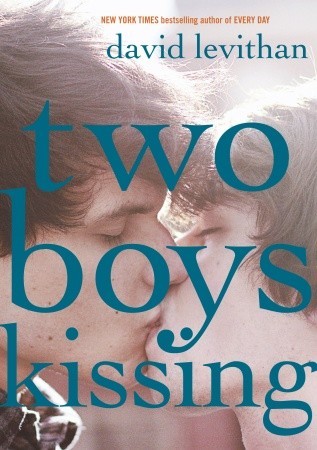
Two Boys KissingTwo Boys Kissing by David Levithan


New York Times  bestselling author David Levithan tells the based-on-true-events story of Harry and Craig, two 17-year-olds who are about to take part in a 32-hour marathon of kissing to set a new Guinness World Record—all of which is narrated by a Greek Chorus of the generation of gay men lost to AIDS. 

While the two increasingly dehydrated and sleep-deprived boys are locking lips, they become a focal point in the lives of other teen boys dealing with languishing long-term relationships, coming out, navigating gender identity, and falling deeper into the digital rabbit hole of gay hookup sites—all while the kissing former couple tries to figure out their own feelings for each other. (blurb from Goodreads)

Rating: PG, 5 stars
Trigger warnings: homophobia, AIDS, suicide attempt

This book. Oh, I have all the feelings for this book. Let’s start with the fact that I read this entire book in one sitting. In about two and a half hours. And I cried almost the entire time. Seriously, I started crying within the first five pages, and although I cry a lot when I read, it’s usually at the end of the book, not at the beginning.

The book starts out with the “Greek Chorus” of men who were lost to AIDS, written in a poetic and immediately-evocative style. Because I’m me and once I’m interested in a book, I don’t go back and read the blurb when I actually start to read the book, I didn’t realize that this was a sort of framing narrative for the novel. Although I’d assumed the entire book would be written in that fashion, I wasn’t disappointed when it shifted focus onto specific, living characters. All in all, I thought the writing struck that balance between plot-driven and poetic, catching the attention of both readers who appreciated every individual word and readers who focus on the bigger picture.

There were times that I found myself frustrated by the overwhelming focus on gay men, an already-dominant demographic in LGBTQ literature. However, I felt like this book was very clearly the story of gay men, and so the lack of bisexual and lesbian characters did not feel as harmful as it could have been. Two Boys Kissing doesn’t market itself as queer YA but as gay YA. Others may disagree with me, but even though the lack of other queer identities was frustrating, I was ultimately ok with it.

*SPOILER* I think part of why I loved this book so much is because it kept seeming like it would be a sad book, but everything ended on a positive, hopeful note. It’s so important to have books with gay characters who face a lot of the same problems other gay teens face without those problems being sugar-coated. By ending the book on a hopeful note instead of a “happily-ever-after” note, it felt both realistic and positive. *END SPOILER*

All in all, this was an excellent book. The writing is good, the characters are sympathetic, and it is gripping enough to make me read it in one sitting.

Sunday, December 1, 2013

Bi: Notes for a Bisexual Revolution by Shiri Eisner


Bi: Notes for a Bisexual RevolutionBi: Notes for a Bisexual Revolution by Shiri Eisner

Depicted as duplicitous, traitorous, and promiscuous, bisexuality has long been suspected, marginalized, and rejected by both straight and gay communities alike.

Bi takes a long overdue, comprehensive look at bisexual politics—from the issues surrounding biphobia/monosexism, feminism, and transgenderism to the practice of labeling those who identify as bi as either "too bisexual” (promiscuous and incapable of fidelity) or "not bisexual enough” (not actively engaging romantically or sexually with people of at least two different genders). In this forward-thinking and eye-opening book, feminist bisexual and genderqueer activist Shiri Eisner takes readers on a journey through the many aspects of the meanings and politics of bisexuality, specifically highlighting how bisexuality can open up new and exciting ways of challenging social convention.

Informed by feminist, transgender, and queer theory, as well as politics and activism, Bi is a radical manifesto for a group that has been too frequently silenced, erased, and denied—and a starting point from which to launch a bisexual revolution. (blurb from Goodreads)

Rating: PG-13, 4 stars
Trigger warnings: see review

This book took me a long time to get through, but not because I didn’t like it. I found it absolutely fascinating. The problem was, with school and all, I often found it hard to focus while I was reading it. In those moments, I would call it fascinating, but dense. From the perspective I have now, from having finished it over Thanksgiving break, I recognize that it wasn’t so much that it was dense, but more that it was more similar to the books I was reading for classes than the books I read for fun. So it took me awhile, but that wasn’t a bad thing.

In a way, I’m glad it took me so long to finish this book, because that gave me plenty of time to process. When it comes to ideological stances, I find that I often either accept or reject the whole of the ideology almost immediately. Not so with this book. I found there were things I definitely agreed with, but there were also things that I definitely disagreed with, and there were even things that I was (and am) on the fence about. It wasn’t comfortable, but I’m glad about that. This isn’t supposed to be a comfortable book. It asks tough questions about what it means to be bisexual, and the answers are no more comfortable than the questions.

This book was incredibly user-friendly. Like many textbooks from my primary school days, it highlighted “vocabulary words” right in the text and defined them in a separate box on the same page. This is very handy for people who might not be familiar with feminist and queer jargon. Trigger warnings were placed before the sections of the book that were relevant, even down to the paragraph, and there were additional “warnings” placed at the end of the triggering sections. I absolutely loved this idea, and I wish more writers (or editors?) took this approach. The availability of trigger warnings within the text is why I didn’t include them above (mostly because I’m slightly lazy and didn’t want to look up specific trigger warnings, because many of them were very specific). All I can say is that Eisner covered her bases when it comes to potentially triggering passages.

One aspect of the book that I definitely have mixed feelings about is the type of parallels she draws between bisexuality and other social issues/oppressed groups. While Eisner always makes clear that true parallels really don’t exist, and that one oppressed group isn’t better/worse off than any other (because you can’t compare them like that), she does often compare the bisexual movement to other movements, and she often chooses movements that she has connections to or experience with, such as trans* movements and movements specific to Israel/Occupied Palestine. This is where the mixed feelings come in. It was often hard for me to make the connections, because she used movements that I really have no familiarity with. This frustrated me, but I also recognize that Eisner isn’t an American author, so it wouldn’t even make sense for her to solely use American social movements, not to mention the fact that movements besides mainstream American social movements deserve attention. I recognize that my frustration comes from a place of privilege, and part of me enjoyed learning about social movements that I really had no prior knowledge of. But I was also frustrated quite a bit. Hence my mixed feelings.

Overall, this book is an excellent, both for bisexuals and those who identify on the queer spectrum, but also for feminists and anyone who is open to learning about bisexual issues. Be prepared to be uncomfortable while reading, maybe even angry--but hopefully you’ll take that discomfort the way I did by appreciating how relevant it is to the discussion this book is starting.

Note: I received a free ebook copy for review, but I also purchased a copy when I was financially able to. 

Wednesday, October 16, 2013

If You Could Be Mine by Sara Farizan

If You Could be Mine by Sara Farizan

In this stunning debut, a young Iranian American writer pulls back the curtain on one of the most hidden corners of a much-talked-about culture.

Seventeen-year-old Sahar has been in love with her best friend, Nasrin, since they were six. They’ve shared stolen kisses and romantic promises. But Iran is a dangerous place for two girls in love—Sahar and Nasrin could be beaten, imprisoned, even executed if their relationship came to light.

So they carry on in secret—until Nasrin’s parents announce that they’ve arranged for her marriage. Nasrin tries to persuade Sahar that they can go on as they have been, only now with new comforts provided by the decent, well-to-do doctor Nasrin will marry. But Sahar dreams of loving Nasrin exclusively—and openly.

Then Sahar discovers what seems like the perfect solution. In Iran, homosexuality may be a crime, but to be a man trapped in a woman’s body is seen as nature’s mistake, and sex reassignment is legal and accessible. As a man, Sahar could be the one to marry Nasrin. Sahar will never be able to love the one she wants, in the body she wants to be loved in, without risking her life. Is saving her love worth sacrificing her true self? (blurb from Goodreads)

Rating: PG-13, 4 1/2 stars
Trigger warnings: homophobia, transphobia, body dysmorphia, child prostitution

This book actually frustrated me quite a bit, but only in the sense that I wanted to reach through the book and shake Sahar several times.  It was very difficult for me to understand how she could be so in love with Nasrin that she would “fake” being trans*, even to the point of undergoing surgery. This frustration wasn’t a bad thing, though. It was fascinating to follow Sahar’s journey, despite how uncomfortable it made me. I also appreciated the fact that the book told the story of a queer teen who isn’t living in White America, which is something that I think a lot of LGBTQ YA does.

This was a really different book for me to read compared with other LGBTQ YA because the culture is so different. It is a contemporary setting non-Western setting, which I think places it in a really unique position. If my memory serves me, this is the first book I’ve read that clearly checks both those boxes. The non-Western-set books I can think of are speculative, and while there is value in building a speculative world around queer culture, I think there’s a different sort of value to taking a contemporary non-Western (and more specifically, a non-American) culture and really delving into what that means for queer-identified characters.

I liked that the setting and overall concept allowed this book to escape so many tropes, not just of queer YA, but of YA fiction in general. This wasn’t a coming out story. From the very beginning, Sahar and the reader know that she is gay. So she isn’t coming to terms with her own sexuality, and the cultural restrictions mean that she can’t safely broach the topic with most of the people in her life. *SPOILER ALERT* I also enjoyed how the book sidestepped the overused YA trope of “protagonist ends up dating forever their first true love.” There are times when I enjoy the trope, but even then I recognize that it’s overused, and it’s so refreshing to see something different. *END SPOILER*

Overall, I just really enjoyed the book. It made me cry (big surprise), and I definitely can’t wait to read the author’s next book.

Sunday, September 22, 2013

Open Letter to Quiet Light by Francesca Lia Block

Open Letter to Quiet Light by Francesca Lia Block

Open Letter to Quiet Light will make readers feel as if they are peering at secret writings meant for the eyes of a lover alone, but these carefully crafted lines somehow transcend the personal to touch everyone who has experienced this kind of consuming, wrenching love.

In these fiercely passionate, devastatingly revealing, sometimes spiritual, and often painful poems, Francesca Lia Block describes in fiery detail the rise and demise of a year-long love affair. Her rich use of language infused with the power of sex and spirit finally paint a transcendent, almost mythic portrait of the way two wounded people—both searching for connection—find each other, collide, and eventually separate. The words seem to bleed onto the page and even the most graphic moments have a devotional quality filled with nuanced expression and unbridled intimacy. (Blurb from Goodreads)

Rating: R, 4 stars
Trigger warnings: Sexual content, miscarriage, cancer

So, as part of my honors thesis, my advisor and I have agreed that I’m to read one book of poetry per week. “Book” is to be defined at my discretion, since obviously I can’t read an entire anthology in a week. Most of these books I likely won’t review, because for whatever reason, I find it really difficult to review poetry. However, Francesca Lia Block is definitely an exception, because I love her work.

I didn’t really take a look at what this collection was about before I selected it. I already owned it, and had been meaning to read it, so it struck me as an obvious choice. I’m glad I picked it, for a variety of reasons. First, the book has a loose (very loose) narrative arc, and my thesis poems are (ideally) going to be based around a narrative. It was really interested to look at a collection of poems that was bound by a cohesive structure while not being as confining as a novel in verse. Something I’m struggling with in my own writing is the idea of balancing between poetry and narrative arc, and Open Letter to Quiet Light made me think about possibly loosening the arc of my collection until it is more implied than told, which is something that I think Block really excelled at in this collection. At all times, I was able to follow the developing relationship without feeling like I was bogged down by the connections between each poem.

At first the book surprised me with it’s sexual content, but I’m really not sure why--it’s not new to me that Block’s writing can be sexually charged, even her poetry (see my reviews of Nymph and Fairy Tales in Electri-City). If you’re already familiar with much of Block’s work (though admittedly more than Weetzie Bat), the sexual content won’t be much of a surprise. For those who are new to Francesca Lia Block, there’s sex, quite a bit of it, in fact.

My one complaint with the collection is that when writing about sex, some words just aren’t poetic, and in certain contexts, they even took me out of the poem a little bit. I’m not exactly sure what she could have done to prevent that besides being less direct, and I did like the directness--so often erotic poetry is wrapped up in innuendo and subtext, and sometimes it’s nice to have everything out in the open. Still, those moments did pull me out of the poetry a little bit.

Un-poetic wording aside, however, I did enjoy this collection. I found myself underlining a lot of particularly enchanting lines or phrases, which is always a sign of love with me and poetry. For fans of Francesca Lia Block, this collection is a must-read.

PS--Sorry for the lack of an update on Wednesday. I’m considering cutting back to one post a week, but hopefully I’ll get a backlog of reviews ready to go soon.

Sunday, September 15, 2013

Sunday Update

I have no review to post today. The school year has started back up in full swing, and I just don't have time to read like I would like to. Or should I say, I have plenty of time to read poetry for my thesis, but I have a really hard time reviewing poetry, so that doesn't really help me. Maybe near the end of the semester I will do a long post about all the poetry I read for my thesis. Maybe.

For now, I thought I'd do a post about writer's block. Specifically, the kind of writer's block where you have so many ideas that you don't know where to start. My honors thesis is a collection of poetry, and I'm working with historical documents. This means that I have an unending supply of inspiration, and that nearly every time I sit down to write, I'm starting fresh. What I'm finding that means is that I have so many general ideas with no ideas of how to start or, for some, how to articulate them. Example: I know I want to do a poem or poems on the idea of taking on a persona and what that means personally and culturally. But that's all I know, and that's a very intellectual way to start a poem. And so I haven't (yet).

This is a situation that I've never really been in before, and I'm interested in seeing how my thesis develops around this problem of having too many ideas and no starting points. I suppose I'll post updates whenever I don't have a review ready to go. :)

Until next time!

Wednesday, September 11, 2013

A Constellation of Vital Phenomena by Anthony Marra

A Constellation of Vital Phenomena by Anthony Marra

A story of the transcendent power of love in wartime, A Constellation of Vital Phenomena is a work of sweeping breadth, profound compassion, and lasting significance.

Two doctors risk everything to save the life of a hunted child in this majestic debut about love, loss, and the unexpected ties that bind us together. “On the morning after the Feds burned down her house and took her father, Havaa woke from dreams of sea anemones.” Havaa, eight years old, hides in the woods and watches the blaze until her neighbor, Akhmed, discovers her sitting in the snow. Akhmed knows getting involved means risking his life, and there is no safe place to hide a child in a village where informers will do anything for a loaf of bread, but for reasons of his own, he sneaks her through the forest to the one place he thinks she might be safe: an abandoned hospital where the sole remaining doctor, Sonja Rabina, treats the wounded. Though Sonja protests that her hospital is not an orphanage, Akhmed convinces her to keep Havaa for a trial, and over the course of five extraordinary days, Sonja’s world will shift on its axis and reveal the intricate pattern of connections that weaves together the pasts of these three unlikely companions and unexpectedly decides their fate. (blurb from Goodreads)

Rating: R, 5 stars
Trigger warnings: violence, torture, sexual assault, sex slavery

I’ve tried mentally writing this review several times, but I keep getting caught up in, “AAAAAH, it’s so beautiful.” Seriously, this novel captivated me with it’s writing, and with the way it wove everything together. I love novels that leave me actively wondering how everything is connected until, one by one, pieces start falling into place, and I am able to draw conclusions, not because the author is sloppy, but because it’s completely intentional. I love this book so very much.

I will admit, though, that for as much as I loved this book, there were moments I was confused. I’m not sure if this a weakness of the book or merely a moment where my education is lacking: I really felt like I was missing so much context for the situation in Chechnya. For the first few chapters, I kept double-checking the year the book was set, because I was so surprised that things in Chechnya were that bad in 2004 and I had never heard about it. Again, that could easily just be a problem with my education, but it was disconcerting to feel like I had no contextual background.

I really admire the way that Marra wove together so many threads from the lives of different characters into a whole tapestry. Throughout the first half of the novel, there were many times when I wondered where everything could possibly be going, and then miraculously it came together to paint a lovely and sad whole picture. Where I writing an analytical paper on this book, I might write paragraphs about how his well-rounded characters capture the human condition and reveal the ties between all of us. But since this is just a review, I’ll leave it at that.

I wish there was more I could form into cohesive thoughts, but I’m still too emotionally close to this book. If you can handle violence, including sexual violence, and have even the remotest interest in literary fiction, I urge you to read A Constellation of Vital Phenomena. It truly is a beautiful book.

Sunday, September 8, 2013

Back to School Time!

Sorry for the lack of updates this week. I'm back at school now, and the settling into a new routine + schoolwork and actual work really kicked my butt this past week. Have no fear, updates will resume as normal on Wednesday. :) Until then, I hope everyone is able to find something lovely to read!

~LovelyReader

Sunday, September 1, 2013

Letters from Skye by Jessica Brockmole

Letters from Skye by Jessica Brockmole

A sweeping story told in letters, spanning two continents and two world wars, Jessica Brockmole’s atmospheric debut novel captures the indelible ways that people fall in love, and celebrates the power of the written word to stir the heart.

March 1912: Twenty-four-year-old Elspeth Dunn, a published poet, has never seen the world beyond her home on Scotland’s remote Isle of Skye. So she is astonished when her first fan letter arrives, from a college student, David Graham, in far-away America. As the two strike up a correspondence—sharing their favorite books, wildest hopes, and deepest secrets—their exchanges blossom into friendship, and eventually into love. But as World War I engulfs Europe and David volunteers as an ambulance driver on the Western front, Elspeth can only wait for him on Skye, hoping he’ll survive.

June 1940: At the start of World War II, Elspeth’s daughter, Margaret, has fallen for a pilot in the Royal Air Force. Her mother warns her against seeking love in wartime, an admonition Margaret doesn’t understand. Then, after a bomb rocks Elspeth’s house, and letters that were hidden in a wall come raining down, Elspeth disappears. Only a single letter remains as a clue to Elspeth’s whereabouts. As Margaret sets out to discover where her mother has gone, she must also face the truth of what happened to her family long ago. (blurb from Goodreads)

Rating: PG-13, 5 stars
Trigger warnings: death, war, mentions of miscarriage and abortion

Oh this book, where to begin? I suppose I could start with the fact that about 20 or so pages from the end, I started crying and didn’t stop until well after I had finished. I didn’t anticipate this being a crying book (and I cry a lot when I read. Actually, I just cry a lot in general), and I’m still not completely sure why it emotionally impacted me so strongly, but I’m glad it did. I always consider it a form of praise if a book elicits a visible emotional reaction from the reader. Letters from Skye succeeded in that many times over.

As you might be able to guess from the title, Letters from Skye is a novel told entirely in letters. It certainly isn’t the first novel to do so, but it’s definitely the most well-done of the ones I’ve seen. This works so well in part because the voice is so genuine. Brockmole did an excellent job of writing characters with distinct and different voices. As an American, Davey uses different vocabulary from Elspeth, and since Margaret spent most of her life in Edinburgh, her letters have less of the Scottish highlands language than Elspeth’s do. The writing style took me straight into the time period, and the different letters took me from Chicago to Skye to London.

The period details worked especially well at not making the story overly sentimental. As a hopeless romantic, this book checked all the right boxes for me, and with its World War era atmosphere (the commonness of writing letters, the sense of urgency in relationships), I didn’t feel like any of it was over the top. This is a love story, so if romances aren’t your thing, this might not be a good choice for you. However, it isn’t sappy or overdone.

I think my biggest disappointment with Letters from Skye is that it isn’t a true story. The language was so real, and the characters felt so alive, that there were times when I almost convinced myself it was true, that Brockmole merely found a trunk of letters somewhere and compiled them into a book. In addition, there was one letter that I thought was borderline unrealistic. By the end of the letter, I though the details included were justified, but it still seemed a little like maid-and-butler talk. That’s only one letter out of a whole book, though--hardly worth noting.

Fans of historical fiction and romance novels are likely to enjoy Letters from Skye, and do to the skillful writing, I also recommend it to those who favor literary fiction. Or everyone. That works, too.

PS--A big heck yeah to all the reviewers who wrote their reviews as a letter. I wanted to, but I’m very particular about keeping my format. :P

Wednesday, August 28, 2013

Wild, Weird, and Wonderful by F.W. Glasier

Wild, Weird, and Wonderful by F.W. Glasier

In both glory and grit, these remarkable photographs give us the American circus during the most vibrant period in its history, capturing both the intensity of the routines and the spirit of camaraderie of the performers. Glasier's work was unique in many ways, not the least of which was the offhand elegance he allowed his subjects, even the wonderful animals. His striking portraits make us recall the sober and revealing work of August Sander. (blurb from Goodreads)

Rating: PG, 4 stars
Trigger Warnings: racist/ableist language

There’s probably going to be an influx of circus-related books on the blog, as I’m writing an honors thesis about the circus this coming school year and have to do lots of research. I was really excited when I found this book, because it covers the time period I’m working with (turn-of-the-century) in photographs. It’s surprisingly hard to find old photos of the circus, particularly the kind of photos I want from the time period I want.

These photographs were all really cool, and the captions, when possible, gave a lot of details about the who, what, where, when, and why of each photograph. It was not at all a text-heavy book, but it’s a good companion to reference books and books like Queen of the Air, which I hope to read and review in the near future.

In the captions there is some language that could be considered racist or ableist. I appreciate the efforts to keep early 1900s circus jargon intact, but I did wonder sometimes about the manner in which that was done.

If you have any interest in circuses, or even turn-of-the-century Americana, this book is worth a look through. It won’t take too long, and the photographs really are a fascinating look at daily life for circus employees of that era.


Sunday, August 25, 2013

The Ocean at the End of the Lane by Neil Gaiman

The Ocean at the End of the Lane by Neil Gaiman

Sussex, England. A middle-aged man returns to his childhood home to attend a funeral. Although the house he lived in is long gone, he is drawn to the farm at the end of the road, where, when he was seven, he encountered a most remarkable girl, Lettie Hempstock, and her mother and grandmother. He hasn't thought of Lettie in decades, and yet as he sits by the pond (a pond that she'd claimed was an ocean) behind the ramshackle old farmhouse, the unremembered past comes flooding back. And it is a past too strange, too frightening, too dangerous to have happened to anyone, let alone a small boy.

Forty years earlier, a man committed suicide in a stolen car at this farm at the end of the road. Like a fuse on a firework, his death lit a touchpaper and resonated in unimaginable ways. The darkness was unleashed, something scary and thoroughly incomprehensible to a little boy. And Lettie—magical, comforting, wise beyond her years—promised to protect him, no matter what.

A groundbreaking work from a master, The Ocean at the End of the Lane is told with a rare understanding of all that makes us human, and shows the power of stories to reveal and shelter us from the darkness inside and out. It is a stirring, terrifying, and elegiac fable as delicate as a butterfly's wing and as menacing as a knife in the dark. (Blurb from Goodreads)

Rating: PG, 5 stars
Trigger warnings: death, nightmares, animal death

This book was amazing, and I hope I’m actually able to get my thoughts down in a coherent manner, because really my reaction is: dskdkdsfsldsfjkfdjfgjdsfjldskfddsfjksogood.

For starters, I loved the fact that we didn’t know the narrator’s name. This is a narrative technique that doesn’t always work, but here it did, partially because it just made me picture Neil Gaiman as the narrator, and he really worked as the narrator.

I loved the way the story unfolded, from the set up at the beginning, to the unfolding of past memories, to the surprising conclusion (a conclusion which I definitely will not be spoiling). The story’s structure left me surprised but not confused or left behind, which can be challenging to do.

I think the unnamed narrator is someone that many readers can relate to--he is an avid reader himself, and that influences so many of his decisions. Because most of the book takes place when he is a child, this characteristic felt realistic and not like a cop-out, which I think would have happened if the narrator, as an adult, was still referencing books all the time.

I loved Lettie and her family. I loved their toughness and their timelessness. I loved that we never really get clear answers about the Hempstocks and what they do, what they’re there for. I loved their farmhouse.

I even loved the shortness of the book (bear with me here). It’s not that I wanted the story to end, because I certainly didn’t, but there’s something romantic about short, powerful novels. And from my own experience, brevity is challenging. It’s easy to fill 400 pages, much harder to cut that down. Kudos to Gaiman for writing such a brilliant little book.

Ugh, this review feels so...lacking after my initial emotional reaction to The Ocean at the End of the Lane. Just read it. You won’t regret it.