Showing posts with label YA. Show all posts

Sunday, March 9, 2014

The Elementals by Saundra Mitchell

The Elementals by Saundra Mitchell

Kate Witherspoon has lived a bohemian life with her artist parents. In 1917, the new art form of the motion picture is changing entertainment—and Kate is determined to become a director.

Meanwhile, midwestern farm boy Julian Birch has inherited the wanderlust that fueled his parents’ adventures. A childhood bout with polio has left him crippled, but he refuses to let his disability define him.

Strangers driven by a shared vision, Kate and Julian set out separately for Los Angeles, the city of dreams. There, they each struggle to find their independence. When they finally meet, the teenage runaways realize their true magical legacy: the ability to triumph over death, and over time. But as their powerful parents before them learned, all magic comes with a price. (blurb from Goodreads)

Ratings: PG-13, 4 stars
Trigger warnings: homophobia, ableism

I read this entire novel without realizing that it was the final book in a series. Oops. Surprisingly, I didn’t feel like I was missing anything except perhaps a little bit of background information about Kate and Julian’s parents. It’s my understanding that The Elementals is a little bit more of a companion novel than the first two books in the trilogy, as it deals with the children of the protagonists of the first two books. I was a little confused about the motivation of the main antagonist, but it didn’t really detract from my enjoyment of the novel.

*SPOILER ALERT* Before reading this book, I’d heard quite a bit of buzz about this book because Kate is bisexual and it’s a period book, which is so rarely done, especially in YA fiction. I found this buzz to be a little...misleading. Kate never fully articulates her feelings towards the woman she is assumed to be in love with, and while I didn’t expect to actually see the word “bisexual” in a text set in 1917, I had hoped for more specific acknowledgement of her feelings. However, I do still appreciate the inclusion of potential bisexuality, and I thought what little was there to be appropriately handled. *END SPOILER*

In general, I really enjoyed the world building in this novel. I thought the period details were really well done, and the magic system was incredibly intuitive. I never questioned it, which is even more impressive considering that this is the final book in a trilogy. I appreciated that the book was more focused on introspective and character relationships than action, despite the magic and menacing antagonist. Even the ending, which could have been very action-y, played out almost gently.

And speaking of the ending, I am speechless. I’ll admit it: I bawled like a baby. I have a weird feeling about the whole thing. I’m not happy about the ending, per se, but I think it’s very fitting and was very satisfying. Prepare yourself for the ending.

In general, I really enjoyed this book, and I recommend it without reservation. As you might expect from a book set in 1917, some characters exhibit homophobia and ableism, but these instances are always framed negatively. I think fans of the Gemma Doyle trilogy might be particularly interested in The Elementals.

Sunday, February 9, 2014

The Chaos of Stars by Kiersten White

The Chaos of Stars by Kiersten White

Kiersten White, New York Times bestselling author of Paranormalcy, is back with The Chaos of Stars—an enchanting novel set in Egypt and San Diego that captures the magic of first love and the eternally complicated truth about family.

Isadora's family is seriously screwed up—which comes with the territory when you're the human daughter of the ancient Egyptian gods Isis and Osiris. Isadora is tired of living with crazy relatives who think she's only worthy of a passing glance—so when she gets the chance to move to California with her brother, she jumps on it. But her new life comes with plenty of its own dramatic—and dangerous—complications . . . and Isadora quickly learns there's no such thing as a clean break from family.

Blending Ally Carter's humor and the romance of Cynthia Hand's Unearthly, The Chaos of Stars takes readers on an unforgettable journey halfway across the world and back, and proves there's no place like home. (blurb from Goodreads)

Rating: PG-13, 4 stars
Trigger warning: violence, familial dysfunction

I had some really mixed feelings about this book in the beginning. For awhile, particularly in the middle, it seemed as though Isadora was suffering painfully from “oblivious protagonist is oblivious” syndrome. Towards the climax of the book, that aspect of her character is resolved in a way that I totally didn’t expect. I won’t spoil anything, but I will say that I was really impressed when my frustration was nullified.

I also had a little trouble relating to Isadora for most of the book. She is incredibly stubborn, and I had a hard time empathizing with how strongly she was trying to break away from her family. However, that isn’t necessarily a detriment to the book. I don’t want to read books with protagonists who I totally and completely understand, because that means that they’re all the same, and they’re all like me, and that doesn’t sound like fun at all.

When I started this book, I was immediately drawn in by the writing. It’s not consistently the best, but there are moments where the language really shines, and as a poet, I always appreciate that. It also did a good job of surprising me with plot twists that I definitely didn’t see coming, which I find often doesn’t happen with YA paranormal romance novels.

Overall, The Chaos of Stars had some flaws, but it also used mythology in an innovative way (look, they’re not all Greek!), and used interesting language to boot! I recommend it if you like mythological tales and are looking for something that takes mythology in a different direction.

Sunday, December 8, 2013


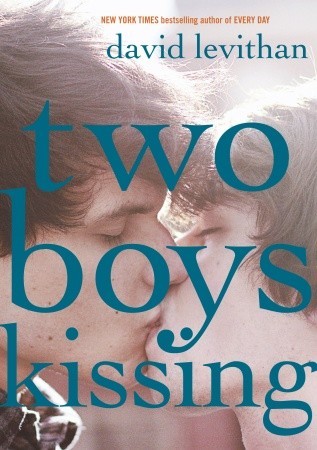
Two Boys KissingTwo Boys Kissing by David Levithan


New York Times  bestselling author David Levithan tells the based-on-true-events story of Harry and Craig, two 17-year-olds who are about to take part in a 32-hour marathon of kissing to set a new Guinness World Record—all of which is narrated by a Greek Chorus of the generation of gay men lost to AIDS. 

While the two increasingly dehydrated and sleep-deprived boys are locking lips, they become a focal point in the lives of other teen boys dealing with languishing long-term relationships, coming out, navigating gender identity, and falling deeper into the digital rabbit hole of gay hookup sites—all while the kissing former couple tries to figure out their own feelings for each other. (blurb from Goodreads)

Rating: PG, 5 stars
Trigger warnings: homophobia, AIDS, suicide attempt

This book. Oh, I have all the feelings for this book. Let’s start with the fact that I read this entire book in one sitting. In about two and a half hours. And I cried almost the entire time. Seriously, I started crying within the first five pages, and although I cry a lot when I read, it’s usually at the end of the book, not at the beginning.

The book starts out with the “Greek Chorus” of men who were lost to AIDS, written in a poetic and immediately-evocative style. Because I’m me and once I’m interested in a book, I don’t go back and read the blurb when I actually start to read the book, I didn’t realize that this was a sort of framing narrative for the novel. Although I’d assumed the entire book would be written in that fashion, I wasn’t disappointed when it shifted focus onto specific, living characters. All in all, I thought the writing struck that balance between plot-driven and poetic, catching the attention of both readers who appreciated every individual word and readers who focus on the bigger picture.

There were times that I found myself frustrated by the overwhelming focus on gay men, an already-dominant demographic in LGBTQ literature. However, I felt like this book was very clearly the story of gay men, and so the lack of bisexual and lesbian characters did not feel as harmful as it could have been. Two Boys Kissing doesn’t market itself as queer YA but as gay YA. Others may disagree with me, but even though the lack of other queer identities was frustrating, I was ultimately ok with it.

*SPOILER* I think part of why I loved this book so much is because it kept seeming like it would be a sad book, but everything ended on a positive, hopeful note. It’s so important to have books with gay characters who face a lot of the same problems other gay teens face without those problems being sugar-coated. By ending the book on a hopeful note instead of a “happily-ever-after” note, it felt both realistic and positive. *END SPOILER*

All in all, this was an excellent book. The writing is good, the characters are sympathetic, and it is gripping enough to make me read it in one sitting.

Wednesday, October 16, 2013

If You Could Be Mine by Sara Farizan

If You Could be Mine by Sara Farizan

In this stunning debut, a young Iranian American writer pulls back the curtain on one of the most hidden corners of a much-talked-about culture.

Seventeen-year-old Sahar has been in love with her best friend, Nasrin, since they were six. They’ve shared stolen kisses and romantic promises. But Iran is a dangerous place for two girls in love—Sahar and Nasrin could be beaten, imprisoned, even executed if their relationship came to light.

So they carry on in secret—until Nasrin’s parents announce that they’ve arranged for her marriage. Nasrin tries to persuade Sahar that they can go on as they have been, only now with new comforts provided by the decent, well-to-do doctor Nasrin will marry. But Sahar dreams of loving Nasrin exclusively—and openly.

Then Sahar discovers what seems like the perfect solution. In Iran, homosexuality may be a crime, but to be a man trapped in a woman’s body is seen as nature’s mistake, and sex reassignment is legal and accessible. As a man, Sahar could be the one to marry Nasrin. Sahar will never be able to love the one she wants, in the body she wants to be loved in, without risking her life. Is saving her love worth sacrificing her true self? (blurb from Goodreads)

Rating: PG-13, 4 1/2 stars
Trigger warnings: homophobia, transphobia, body dysmorphia, child prostitution

This book actually frustrated me quite a bit, but only in the sense that I wanted to reach through the book and shake Sahar several times.  It was very difficult for me to understand how she could be so in love with Nasrin that she would “fake” being trans*, even to the point of undergoing surgery. This frustration wasn’t a bad thing, though. It was fascinating to follow Sahar’s journey, despite how uncomfortable it made me. I also appreciated the fact that the book told the story of a queer teen who isn’t living in White America, which is something that I think a lot of LGBTQ YA does.

This was a really different book for me to read compared with other LGBTQ YA because the culture is so different. It is a contemporary setting non-Western setting, which I think places it in a really unique position. If my memory serves me, this is the first book I’ve read that clearly checks both those boxes. The non-Western-set books I can think of are speculative, and while there is value in building a speculative world around queer culture, I think there’s a different sort of value to taking a contemporary non-Western (and more specifically, a non-American) culture and really delving into what that means for queer-identified characters.

I liked that the setting and overall concept allowed this book to escape so many tropes, not just of queer YA, but of YA fiction in general. This wasn’t a coming out story. From the very beginning, Sahar and the reader know that she is gay. So she isn’t coming to terms with her own sexuality, and the cultural restrictions mean that she can’t safely broach the topic with most of the people in her life. *SPOILER ALERT* I also enjoyed how the book sidestepped the overused YA trope of “protagonist ends up dating forever their first true love.” There are times when I enjoy the trope, but even then I recognize that it’s overused, and it’s so refreshing to see something different. *END SPOILER*

Overall, I just really enjoyed the book. It made me cry (big surprise), and I definitely can’t wait to read the author’s next book.

Sunday, August 18, 2013

Mermaid in Chelsea Creek by Michelle Tea

Mermaid in Chelsea Creek by Michelle Tea

Everyone in the broken-down town of Chelsea, Massachusetts, has a story too worn to repeat—from the girls who play the pass-out game just to feel like they're somewhere else, to the packs of aimless teenage boys, to the old women from far away who left everything behind. But there’s one story they all still tell: the oldest and saddest but most hopeful story, the one about the girl who will be able to take their twisted world and straighten it out. The girl who will bring the magic.

Could Sophie Swankowski be that girl? With her tangled hair and grubby clothes, her weird habits and her visions of a filthy, swearing mermaid who comes to her when she’s unconscious, Sophie could be the one to uncover the power flowing beneath Chelsea’s potholed streets and sludge-filled rivers, and the one to fight the evil that flows there, too. Sophie might discover her destiny, and maybe even in time to save them all. (blurb from Goodreads)

Rating: PG, 4 1/2 stars
Trigger Warnings: OCD/Compulsions, alcoholism, animal death, neglectful parents, bullying

I’m not going to lie: this was a fairly dark book. It was gritty; it was dirty (and I don’t mean smutty; I mean there was a lot of dirt in the book). But for all of that, I found it surprisingly hopeful, and not just in the sense that it ended on a hopeful note. What I mean is that this book gave me hope for the future of humankind.

Despite the magical realism present in Mermaid in Chelsea Creek, I felt that Sophie’s destiny really resonated with a lot of things that are actually happening in the world today.  Sophie’s job is to, in a manner of speaking, rid the humanity of its darkness, of the sorrow and hatred and violence. Reading that, I thought of the bees that are dying from the use of pesticides and fungicides, America’s problem with gun violence, the violent revolutions currently taking place in South America and the Middle East. For some reason, the idea of an almost-high schooler taking the plunge to save us all despite her doubts and fears and the fact that she’s fighting her grandmother gives me hope for the future. Maybe it’s the fact that the solutions to these problems will likely come from today’s youth. Maybe I’m crazy. Maybe I should move on to a different point before I get super-political.

The first couple chapters of Mermaid in Chelsea Creek were a little slow, and I almost didn’t finish the book because of it. However, I’m definitely glad that I did, and the pacing does pick up a few chapters in.

I loved the references to the Polish language and culture. I come from a very Eastern-European family, and you really don’t see a lot of that heritage showing up in contemporary (or even historical) YA novels. It seems to me that whenever “heritage” is important to a character, it’s English, French, Irish, Italian, etc. (Taking a moment here to check my white privilege. Eastern Europeans may not show up as much in books as Western Europeans, but I know it’s more than those of non-European descent). I loved seeing phrases in Polish. I loved the shout-out to immigrant culture and the pain of losing language and culture.

While reading, I encountered phrases and passages that reminded me of Francesca Lia Block’s writing, which for me was great, because I love that writing style. It isn’t for everyone, but I can imagine that fans of Block or magical realism in general will have no problems with the writing style.

I’ll admit I was slightly disappointed to realize that this wasn’t a self-contained book. It’s not that I don’t want to read more, because I really do. I just get a little tired of so many YA series/trilogies/etc. Speaking as a writer, self-contained works are a greater challenge, at least for me, and I’m dying to see more in the market. But...you can bet your ass that I’m going to read the sequel when it comes out.

I put quite a few trigger warnings at the top of this review. Quick breakdown: Sophie’s best friend is a germaphobe who scrubs her skin raw when she feels dirty (this happens a lot due to the places in Chelsea that she and Sophie frequent). There is a character who is an alcoholic, although his page-time in the story is minimal. Several animals die towards the end of the book. Sophie’s mom, while she certainly isn’t abusive, is not particularly affectionate towards her daughter. In many instances this is noted by a lack of compassion and understanding coupled with neglect. There is a scene where Sophie confronts some boys who bully her. I can’t recall if there were any insinuations of a sexual nature, but I think there might have been (I already returned to the book to the library, so I can’t look it up. :/). Despite the numerous trigger warnings, I really do consider this book to be quite hopeful. I whole-heartedly recommend it, and I can’t wait for the next book.

Wednesday, July 31, 2013

Huntress by Malinda Lo

Huntress by Malinda Lo


Nature is out of balance in the human world. The sun hasn't shone in years, and crops are failing. Worse yet, strange and hostile creatures have begun to appear. The people's survival hangs in the balance.
To solve the crisis, the oracle stones are cast, and Kaede and Taisin, two seventeen-year-old girls, are picked to go on a dangerous and unheard-of journey to Tanlili, the city of the Fairy Queen. Taisin is a sage, thrumming with magic, and Kaede is of the earth, without a speck of the otherworldly. And yet the two girls' destinies are drawn together during the mission. As members of their party succumb to unearthly attacks and fairy tricks, the two come to rely on each other and even begin to fall in love. But the Kingdom needs only one huntress to save it, and what it takes could tear Kaede and Taisin apart forever.
The exciting adventure prequel to Malinda Lo's highly acclaimed novel Ash is overflowing with lush Chinese influences and details inspired by the I Ching, and is filled with action and romance. (blurb from Goodreads)


Rating: PG-13, 4 1/2 stars
Trigger Warnings: battle/fight scenes, violence, animal attacks, violence directed at children and babies, death


I actually enjoyed Huntress much more than Ash. Lo worked with a larger cast of characters in Huntress than Ash, and consequently there were a lot more characters that I sympathised with. Maybe it was because of the omniscient narration, but I cared about more than just Kaede and Taisin. I enjoyed the moments that focused more on Prince Con and the other members of their traveling party.


Those who have read Ash may recognize the bare bones of the story as one of fairy tales from Ash’s time. Since this is a prequel, Huntress is set in the same world as Ash, just much earlier in history. I really enjoyed the connections, particularly the transformation of the events in Huntress to the folklore in Ash. However, the two novels are not directly connected in terms of characters and immediate setting; you can definitely read one without the other.


I was surprised at the extent of the romance in the story. It is definitely more of an adventure novel than Ash, but the romance was still a main focus. I’d say for at least 90% of the novel there was a good balance between the romance and the action. There were a few moments when I felt the focus shifted too much to one side, but they were very rare.


I thought the the world-building was done very well, and I particularly like Lo’s take on traditional faerie lore. I liked the fact that not all of her fey were explicitly antagonistic. I liked the combination of traditional Celtic Sidhe with the Chinese-influenced spelling “Xi.” And I have to say, I really appreciate it when authors work the whole iron thing into their faerie stories.


*SPOILER* My biggest complaint with Huntress was the unicorn sub-plot at the end. It makes sense in context with Ash, because that part did play a part in Ash. However, I felt like it’s placement in the story made the ending a little anti-climactic for the amount of time given to the unicorn scene. I knew that I was like ten pages from the end of the book, and all of a sudden Kaede is sent on another mission. That just bothered me a little. However, I will say that I appreciate what that scene did for Kaede’s character. *END SPOILER*


There was quite a bit of violence in the book, including a scene where the characters were attacked by wolves, and two scenes that featured violence against infant-like creatures. In addition, some characters do die. So generally speaking, if violence bothers you, you might want to hold off on Huntress, or at least take it slowly. The violence was in no way out of place, given the story, but it was very much there.


All in all, I really enjoyed Huntress. I look forward to reading more of Lo’s work, and I hope she returns to the setting of Ash and Huntress in the future.

Sunday, July 14, 2013

Dualed by Elsie Chapman

Dualed by Elsie Chapman

You or your Alt? Only one will survive.

The city of Kersh is a safe haven, but the price of safety is high. Everyone has a genetic Alternate—a twin raised by another family—and citizens must prove their worth by eliminating their Alts before their twentieth birthday. Survival means advanced schooling, a good job, marriage—life.

Fifteen-year-old West Grayer has trained as a fighter, preparing for the day when her assignment arrives and she will have one month to hunt down and kill her Alt. But then a tragic misstep shakes West’s confidence. Stricken with grief and guilt, she’s no longer certain that she’s the best version of herself, the version worthy of a future. If she is to have any chance of winning, she must stop running not only from her Alt, but also from love . . . though both have the power to destroy her.

Elsie Chapman's suspenseful YA debut weaves unexpected romance into a novel full of fast-paced action and thought-provoking philosophy. When the story ends, discussions will begin about this future society where every adult is a murderer and every child knows there is another out there who just might be better. (blurb from Goodreads)

Rating: R, 4 1/2 stars
Trigger warnings: graphic violence, death, familial death

I have a weird relationship with this book. I absolutely enjoyed it, but I had to take it really slow because parts were so intense. I’m not one for adrenaline--in fact, I hate most adrenaline-inducing activities. This book was quite adrenaline-inducing for me. At one point, I actually dreamed how I thought the book should end. It was rather bizarre that I physiologically reacted so strongly to this book, but don’t think that that’s a problem. Those reactions riveted me to the outcome of the novel.

It’s interesting, and I may get a lot of hate for this, but even though this book reminded me conceptually of The Hunger Games, I really did enjoy this book while I couldn’t finish The Hunger Games. I’m not sure why that is exactly, but I know that I appreciate West’s attitude from the beginning, while Katniss’ character is one of the reasons that I couldn’t finished The Hunger Games. I thought it was interesting to take such a violent concept and make it both individual and urban. I find that a lot of dystopian fiction is either violent on a grander scale or individual violence is moved out of an urban environment, even if that environment is merely a city park. For that matter, I enjoyed that Dualed rarely left it’s gritty urban setting. There was no green oasis that West retired to to take a break and wax philosophical about what her society meant. She was always on the move.
In the end, I think one of the reasons I liked this book so much was the pacing. The book is fast-paced from the beginning and it never slows down. For some books that doesn’t work, but I thought it worked really well in Dualed.

I’m intrigued by the fact that there is a sequel due for Dualed, and I’m really hoping it is as engaging as the first. I definitely recommend Dualed to any dystopian fans who don’t mind violence, because the book is really quite violent.

Sunday, July 7, 2013

The Selection by Kiera Cass

The Selection by Keira Cass

For thirty-five girls, the Selection is the chance of a lifetime. The opportunity to escape the life laid out for them since birth. To be swept up in a world of glittering gowns and priceless jewels. To live in a palace and compete for the heart of gorgeous Prince Maxon.

But for America Singer, being Selected is a nightmare. It means turning her back on her secret love with Aspen, who is a caste below her. Leaving her home to enter a fierce competition for a crown she doesn't want. Living in a palace that is constantly threatened by violent rebel attacks.

Then America meets Prince Maxon. Gradually, she starts to question all the plans she's made for herself—and realizes that the life she's always dreamed of may not compare to a future she never imagined. (blurb from Goodreads)

Rating: PG-13, 3 stars
Trigger Warnings: violence, mention of sexual assault

I enjoyed this book a lot more than I thought I would. It’s lighthearted fluff, but that doesn’t mean that it can’t be enjoyed...indeed, I found it to be a very pleasant read. Love triangles aren’t anything new at this point, but I liked the setup that Keira Cass chose here, because it allowed America’s relationship with Maxon to really develop unhindered.

I was also pleasantly surprised by non-romantic plot points. I enjoyed the commentary on classism. Basically, I like my dystopian fiction with a political leaning, and The Selection delivered on that front in ways that I honestly wasn’t expecting.

Given the commercial nature of dystopian fiction today, as well as the commercial nature of YA fiction with love-triangles, I wasn’t surprised by the plainness of the writing. The Selection isn’t a book you read for the poetic imagery or the skillful sentences. However, it is a book you read for an interesting plot and engaging characters.

The book started as a light-hearted Bachelorette meets Hunger Games, but you’d be mistaken to assume that there’s no action or that it’s all the girl-vs-girl competition variety. I loved America’s interest in the condition of her country, and how that developed into an understanding of the country’s problems, which was further exacerbated by events in the palace (ok, that’s a little vague, but I’m trying to avoid a spoiler warning here).

Towards the end of the novel, there is some violence, and a character is very obviously triggered. There are also veiled mentions of sexual assault.

I’m quite interested in seeing how Cass continues the series, particularly in the balance between the competition and the growing unrest in the country. Elite, the sequel, will make an excellent summer read, and I look forward to diving in.

Wednesday, July 3, 2013

Ash by Malinda Lo

Ash by Malinda Lo


In the wake of her father's death, Ash is left at the mercy of her cruel stepmother. Consumed with grief, her only joy comes by the light of the dying hearth fire, rereading the fairy tales her mother once told her. In her dreams, someday the fairies will steal her away, as they are said to do. When she meets the dark and dangerous fairy Sidhean, she believes that her wish may be granted.


The day that Ash meets Kaisa, the King's Huntress, her heart begins to change. Instead of chasing fairies, Ash learns to hunt with Kaisa. Though their friendship is as delicate as a new bloom, it reawakens Ash's capacity for love-and her desire to live. But Sidhean has already claimed Ash for his own, and she must make a choice between fairy tale dreams and true love.


Entrancing, empowering, and romantic, Ash is about the connection between life and love, and solitude and death, where transformation can come from even the deepest grief. (blurb from Goodreads)


Rating: PG, 4 stars
Trigger Warnings: some violence, familial/domestic abuse (à la Cinderella)


For the record, Cinderella retellings are my thing. My favorite books as a child include Ella Enchanted, Just Ella, and The Glass Slipper. I don’t know anyone else that has even heard of The Glass Slipper (please shout out if you have!). So when I found Ash on sale over a year ago, I was super pumped. A new Cinderella retelling! Unfortunately, I think it is misleading to bill Ash as a Cinderella retelling. I can definitely see parts of the story that were taken from Cinderella. Ash lives with her stepmother and stepsisters. She works like a servant for them and endures their ridicule and abuse. The prince holds a ball for every eligible maiden in the kingdom. That’s about the end of the Cinderella parallels, though. This isn’t necessarily a bad thing; to the contrary, I really enjoyed this book. I just think it shouldn’t have been marketed as a Cinderella retelling. Because that’s not what it is. More on exactly why it isn’t to come.


But if it’s not a Cinderella retelling, what did I like about it? So. Much. Ash felt so real, so human. Her emotions were so raw, which is something not often found in stories that take inspiration from Cinderella. It was really refreshing to see a fairy tale base made so human and genuine. I enjoyed the world-building. I felt the culture was well-integrated, and the role of the King’s Huntress made me really happy. So many fantasy worlds either stick with the status quo and have their military and influential figures male or equally male and female, and here was a martial position that was for women. I really enjoyed that.


I think one of Malinda Lo’s strong suits in writing is writing the gradual development of relationships. It’s something hard to do, and yet I think Lo captures it beautifully in Ash.


I also enjoyed her adaptation of common Cinderella elements. The use of the name Ash plays to both the novel’s Celtic influences and a synonym for cinders. I enjoyed her substitution of a fairy for the fairy godmother/tree/whatever.


Now for complaints. Er, complaint, since I already went over the not-fairy tale thing. I said I loved the world building, but there was one aspect that was frustratingly missing. *SPOILER?* When Ash starts to realize she has feelings for Kaisa, she is concerned about what people will think. Kaisa is clearly not concerned. Since Ash was a little sheltered from people, I assumed that she just didn’t understand the culture’s view of homosexuality, but I wanted a definitive answer on that. I wanted someone to say something or do something that revealed the general acceptance or lack thereof of homosexuality. This was a major frustration for me. *END SPOILER*


Now, for why this isn’t a fairy tale retelling to me. *SPOILER* For me, Cinderella stories are a lot about the prince. In the original tale and most retellings, he is the catalyst for change. He changes the Cinderella figure’s life, whether that is in a good way or not. In Ash, he’s basically a background character. This isn’t “the prince falls for Ash and she chooses the Huntress anyway.” This isn’t “the princess falls for Ash and she falls for the princess.” This isn’t even “the prince falls for Ash but she likes his sister.” No. The prince is there, but Ash dances with the Huntress and then her fairy boy gets pissed. To me, this departure from the how and the why of Cinderella is why Ash isn’t a fairy tale retelling. It is inspired by Cinderella, but no more than that. *END SPOILER*

All in all, I really enjoyed Ash. There were some moments of frustration, but they didn’t really cloud my enjoyment of the book. I thought the writing was beautiful and the characters well-developed. It’s definitely worth reading.