Showing posts with label tw: homophobia. Show all posts

Sunday, March 9, 2014

The Elementals by Saundra Mitchell

The Elementals by Saundra Mitchell

Kate Witherspoon has lived a bohemian life with her artist parents. In 1917, the new art form of the motion picture is changing entertainment—and Kate is determined to become a director.

Meanwhile, midwestern farm boy Julian Birch has inherited the wanderlust that fueled his parents’ adventures. A childhood bout with polio has left him crippled, but he refuses to let his disability define him.

Strangers driven by a shared vision, Kate and Julian set out separately for Los Angeles, the city of dreams. There, they each struggle to find their independence. When they finally meet, the teenage runaways realize their true magical legacy: the ability to triumph over death, and over time. But as their powerful parents before them learned, all magic comes with a price. (blurb from Goodreads)

Ratings: PG-13, 4 stars
Trigger warnings: homophobia, ableism

I read this entire novel without realizing that it was the final book in a series. Oops. Surprisingly, I didn’t feel like I was missing anything except perhaps a little bit of background information about Kate and Julian’s parents. It’s my understanding that The Elementals is a little bit more of a companion novel than the first two books in the trilogy, as it deals with the children of the protagonists of the first two books. I was a little confused about the motivation of the main antagonist, but it didn’t really detract from my enjoyment of the novel.

*SPOILER ALERT* Before reading this book, I’d heard quite a bit of buzz about this book because Kate is bisexual and it’s a period book, which is so rarely done, especially in YA fiction. I found this buzz to be a little...misleading. Kate never fully articulates her feelings towards the woman she is assumed to be in love with, and while I didn’t expect to actually see the word “bisexual” in a text set in 1917, I had hoped for more specific acknowledgement of her feelings. However, I do still appreciate the inclusion of potential bisexuality, and I thought what little was there to be appropriately handled. *END SPOILER*

In general, I really enjoyed the world building in this novel. I thought the period details were really well done, and the magic system was incredibly intuitive. I never questioned it, which is even more impressive considering that this is the final book in a trilogy. I appreciated that the book was more focused on introspective and character relationships than action, despite the magic and menacing antagonist. Even the ending, which could have been very action-y, played out almost gently.

And speaking of the ending, I am speechless. I’ll admit it: I bawled like a baby. I have a weird feeling about the whole thing. I’m not happy about the ending, per se, but I think it’s very fitting and was very satisfying. Prepare yourself for the ending.

In general, I really enjoyed this book, and I recommend it without reservation. As you might expect from a book set in 1917, some characters exhibit homophobia and ableism, but these instances are always framed negatively. I think fans of the Gemma Doyle trilogy might be particularly interested in The Elementals.

Sunday, January 26, 2014

Blue is the Warmest Color by Julie Maroh

Blue is the Warmest Color by Julie Maroh

Originally published in French as Le bleu est une couleur chaude, Blue is the Warmest Color is a graphic novel about growing up, falling in love, and coming out. Clementine is a junior in high school who seems average enough: she has friends, family, and the romantic attention of the boys in her school. When her openly gay best friend takes her out on the town, she wanders into a lesbian bar where she encounters Emma: a punkish, confident girl with blue hair. Their attraction is instant and electric, and Clementine find herself in a relationship that will test her friends, parents, and her own ideas about herself and her identity.

First published in French by Belgium's Glénat, the book has won several awards, including the Audience Prize at the Angoulême International Comics Festival, Europe's largest. The film Blue Is the Warmest Color won the Palme d'Or at the 2013 Cannes Film Festival.

Julie Maroh is an author and illustrator originally from northern France. (blurb from Goodreads)

Rating: R; 5 stars
Trigger warnings: homophobia, romantic age difference

This book was an absolute beauty, and I am so excited to hear that it’s a movie, too. Not to sound cliché, but it is incredibly French--it differs from American comic books and graphic novels in the same ways that French films differ from American films. In fact, I really want to read it in the original language, because I suspect I’d like it even more in French.

I was a little weirded out at first by the age difference between Clementine and Emma. Clementine is still in high school, and Emma is very clearly an adult. Once they actually had a relationship and weren’t just meeting in a bar, the weirdness factor did go down a bit, but I imagine the age difference between them could be uncomfortable and/or triggering for some readers. Just a word of warning.

The art is beautiful in this book, very detailed, but not overdone. In many places, the dialogue is sparse, allowing the story to continue solely through the artwork. This is one of the ways in which I feel it parallels French film.

Without giving anything away, this isn’t exactly a happy book. I wouldn’t recommend reading it if you’re already sad, because you’ll probably finish it in one sitting, and then you’ll be sadder.

Another word of warning: this book does contain a few sex scenes, and because it’s a graphic novel, they’re, well, graphic. That is pretty much the sole reason I rated Blue is the Warmest Color as R.

Maturity aside, this really is an excellent book. The story is emotionally engaging, the characters are complex, and the art is breathtaking. I wholeheartedly recommend it. As for myself, I will be watching the movie as soon as I can get ahold of it.

Sunday, December 8, 2013


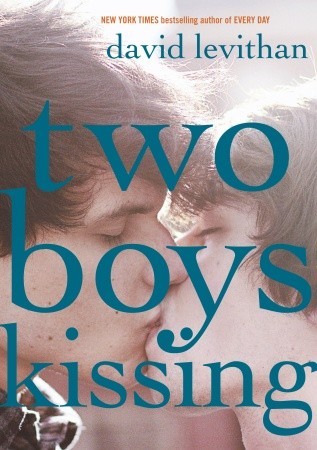
Two Boys KissingTwo Boys Kissing by David Levithan


New York Times  bestselling author David Levithan tells the based-on-true-events story of Harry and Craig, two 17-year-olds who are about to take part in a 32-hour marathon of kissing to set a new Guinness World Record—all of which is narrated by a Greek Chorus of the generation of gay men lost to AIDS. 

While the two increasingly dehydrated and sleep-deprived boys are locking lips, they become a focal point in the lives of other teen boys dealing with languishing long-term relationships, coming out, navigating gender identity, and falling deeper into the digital rabbit hole of gay hookup sites—all while the kissing former couple tries to figure out their own feelings for each other. (blurb from Goodreads)

Rating: PG, 5 stars
Trigger warnings: homophobia, AIDS, suicide attempt

This book. Oh, I have all the feelings for this book. Let’s start with the fact that I read this entire book in one sitting. In about two and a half hours. And I cried almost the entire time. Seriously, I started crying within the first five pages, and although I cry a lot when I read, it’s usually at the end of the book, not at the beginning.

The book starts out with the “Greek Chorus” of men who were lost to AIDS, written in a poetic and immediately-evocative style. Because I’m me and once I’m interested in a book, I don’t go back and read the blurb when I actually start to read the book, I didn’t realize that this was a sort of framing narrative for the novel. Although I’d assumed the entire book would be written in that fashion, I wasn’t disappointed when it shifted focus onto specific, living characters. All in all, I thought the writing struck that balance between plot-driven and poetic, catching the attention of both readers who appreciated every individual word and readers who focus on the bigger picture.

There were times that I found myself frustrated by the overwhelming focus on gay men, an already-dominant demographic in LGBTQ literature. However, I felt like this book was very clearly the story of gay men, and so the lack of bisexual and lesbian characters did not feel as harmful as it could have been. Two Boys Kissing doesn’t market itself as queer YA but as gay YA. Others may disagree with me, but even though the lack of other queer identities was frustrating, I was ultimately ok with it.

*SPOILER* I think part of why I loved this book so much is because it kept seeming like it would be a sad book, but everything ended on a positive, hopeful note. It’s so important to have books with gay characters who face a lot of the same problems other gay teens face without those problems being sugar-coated. By ending the book on a hopeful note instead of a “happily-ever-after” note, it felt both realistic and positive. *END SPOILER*

All in all, this was an excellent book. The writing is good, the characters are sympathetic, and it is gripping enough to make me read it in one sitting.

Wednesday, October 16, 2013

If You Could Be Mine by Sara Farizan

If You Could be Mine by Sara Farizan

In this stunning debut, a young Iranian American writer pulls back the curtain on one of the most hidden corners of a much-talked-about culture.

Seventeen-year-old Sahar has been in love with her best friend, Nasrin, since they were six. They’ve shared stolen kisses and romantic promises. But Iran is a dangerous place for two girls in love—Sahar and Nasrin could be beaten, imprisoned, even executed if their relationship came to light.

So they carry on in secret—until Nasrin’s parents announce that they’ve arranged for her marriage. Nasrin tries to persuade Sahar that they can go on as they have been, only now with new comforts provided by the decent, well-to-do doctor Nasrin will marry. But Sahar dreams of loving Nasrin exclusively—and openly.

Then Sahar discovers what seems like the perfect solution. In Iran, homosexuality may be a crime, but to be a man trapped in a woman’s body is seen as nature’s mistake, and sex reassignment is legal and accessible. As a man, Sahar could be the one to marry Nasrin. Sahar will never be able to love the one she wants, in the body she wants to be loved in, without risking her life. Is saving her love worth sacrificing her true self? (blurb from Goodreads)

Rating: PG-13, 4 1/2 stars
Trigger warnings: homophobia, transphobia, body dysmorphia, child prostitution

This book actually frustrated me quite a bit, but only in the sense that I wanted to reach through the book and shake Sahar several times.  It was very difficult for me to understand how she could be so in love with Nasrin that she would “fake” being trans*, even to the point of undergoing surgery. This frustration wasn’t a bad thing, though. It was fascinating to follow Sahar’s journey, despite how uncomfortable it made me. I also appreciated the fact that the book told the story of a queer teen who isn’t living in White America, which is something that I think a lot of LGBTQ YA does.

This was a really different book for me to read compared with other LGBTQ YA because the culture is so different. It is a contemporary setting non-Western setting, which I think places it in a really unique position. If my memory serves me, this is the first book I’ve read that clearly checks both those boxes. The non-Western-set books I can think of are speculative, and while there is value in building a speculative world around queer culture, I think there’s a different sort of value to taking a contemporary non-Western (and more specifically, a non-American) culture and really delving into what that means for queer-identified characters.

I liked that the setting and overall concept allowed this book to escape so many tropes, not just of queer YA, but of YA fiction in general. This wasn’t a coming out story. From the very beginning, Sahar and the reader know that she is gay. So she isn’t coming to terms with her own sexuality, and the cultural restrictions mean that she can’t safely broach the topic with most of the people in her life. *SPOILER ALERT* I also enjoyed how the book sidestepped the overused YA trope of “protagonist ends up dating forever their first true love.” There are times when I enjoy the trope, but even then I recognize that it’s overused, and it’s so refreshing to see something different. *END SPOILER*

Overall, I just really enjoyed the book. It made me cry (big surprise), and I definitely can’t wait to read the author’s next book.

Wednesday, August 14, 2013

Banished by Lauren Drain and Lisa Pulitzer

Banished: Surviving My Years in the Westboro Baptist Church by Lauren Drain and Lisa Pulitzer

NOW A NEW YORK TIMES BESTSELLER You've likely heard of the Westboro Baptist Church. Perhaps you've seen their pickets on the news, the members holding signs with messages that are too offensive to copy here, protesting at events such as the funerals of soldiers, the 9-year old victim of the recent Tucson shooting, and Elizabeth Edwards, all in front of their grieving families. The WBC is fervently anti-gay, anti-Semitic, and anti- practically everything and everyone. And they aren't going anywhere: in March, the U.S. Supreme Court ruled in favor of the WBC's right to picket funerals. 

Since no organized religion will claim affiliation with the WBC, it's perhaps more accurate to think of them as a cult. Lauren Drain was thrust into that cult at the age of 15, and then spat back out again seven years later. BANISHED is the first look inside the organization, as well as a fascinating story of adaptation and perseverance. 

Lauren spent her early years enjoying a normal life with her family in Florida. But when her formerly liberal and secular father set out to produce a documentary about the WBC, his detached interest gradually evolved into fascination, and he moved the entire family to Kansas to join the church and live on their compound. Over the next seven years, Lauren fully assimilated their extreme beliefs, and became a member of the church and an active and vocal picketer. But as she matured and began to challenge some of the church's tenets, she was unceremoniously cast out from the church and permanently cut off from her family and from everyone else she knew and loved. BANISHED is the story of Lauren's fight to find herself amidst dramatic changes in a world of extremists and a life in exile. (blurb from Goodreads)

Rating: PG-13, 3 stars
Trigger Warnings: emotional abuse, familial abuse, religious abuse, homophobia

The Westboro Baptist Church is pretty well-known today as an organization that pickets funerals and spews hate and negativity, particularly targeted at gay people. When I heard that a former member of the "church" had written a memoir of her time with the organization, I was really interested in seeing what she had to say.

I have to say, I love how balanced the book was. Of course, Lauren Drain left the WBC for a reason, so the book wasn't completely unbiased, but I thought that she painted a compelling picture of her state of mind while she was still in the WBC and how that deteriorated over time. I appreciated recognizing the abuse of her father even while she was explaining how she justified his words at the time.

I also liked being able to the members of the Westboro Baptist Church as people and not just picketeers. I vehemently disagree with everything they stand for, but I appreciated seeing their good sides as well as the bad. Humans are complex creatures, and it is easy to forget sometimes that even people we disagree with are good and bad.

I was particularly intrigued by Drain's portrait of the leaders of WBC. For example, before reading this book, I had no idea that any of the Phelps had jobs outside of the WBC. It didn't surprise me to find out that most of them were lawyers, however.

Due to the nature of the Westboro Baptist Church, the book may be upsetting or even triggering to those on the LGBTQ spectrum, survivors of emotional abuse, those who have had bad experiences with organized religion, and those who are or know people impacted by Westboro Baptist Church's pickets, especially those with ties to 9/11. Even so, the book is a fascinating read for anyone who is curious about the Westboro Baptist Church and would like a rare inside perspective.

Wednesday, July 24, 2013

The Miseducation of Cameron Post by Emily M. Danforth

The Miseducation of Cameron Post by Emily M Danforth

When Cameron Post's parents die suddenly in a car crash, her shocking first thought is relief. Relief they'll never know that, hours earlier, she had been kissing a girl.

But that relief doesn't last, and Cam is soon forced to move in with her conservative aunt Ruth and her well-intentioned but hopelessly old-fashioned grandmother. She knows that from this point on, her life will forever be different. Survival in Miles City, Montana, means blending in and leaving well enough alone (as her grandmother might say), and Cam becomes an expert at both.

Then Coley Taylor moves to town. Beautiful, pickup-driving Coley is a perfect cowgirl with the perfect boyfriend to match. She and Cam forge an unexpected and intense friendship--one that seems to leave room for something more to emerge. But just as that starts to seem like a real possibility, ultrareligious Aunt Ruth takes drastic action to "fix" her niece, bringing Cam face-to-face with the cost of denying her true self--even if she's not exactly sure who that is.

The Miseducation of Cameron Post is a stunning and unforgettable literary debut about discovering who you are and finding the courage to live life according to your own rules. (blurb from Goodreads)

Rating: PG-13, 4 stars
Trigger Warnings: homophobia, ex-gay camp, familial death, drugs, transphobia, sexual content

This was another one of the books that I read while at Plum Village monastery, and like Wildthorn, it eerily paralleled my experiences...must be something about following a more rigid schedule (if you can call a mindful, monastic schedule rigid) while reading about someone following a rigid schedule.

Like Ash, I feel like the blurb to this book was slightly misleading. I expected the majority of the book to take place at the pray-the-gay-away camp and for the book to have a much darker tone overall. I was pleasantly surprised at the lighter tone of the novel and at the depth of the characters. I did not expect to see Cameron struggle so much with her identity or with the death of her parents, and I’m glad she did. It’s refreshing to see a novel with a gay protagonist who struggles not with coming out, but accepting her identity and coming to terms with how that will affect those around her in both positive and negative terms. It was also nice to see that the main focus of the novel was not a romance. There were some flings throughout the course of the novel, but they absolutely were not the main plot.

Given that this is essentially a book about a lesbian teenager in the 80s subverting her aunt’s conservative Christian culture, I wasn’t surprised at the swearing and drug content, but some might be bothered by it. Nothing stronger than marijuana is ever used in the book, but there is swearing left and right, as you might expect from the rural Montana setting. There are also some rather sexual dream scenes that culminate in a non-dream sexual scene.

All in all, this was a really pleasant read full of realism and well-developed characters. The Miseducation of Cameron Post does an excellent job of dealing with some heavy topics while still remaining a moderately light-hearted novel. I recommend it for fans of contemporary YA, (recent) historical YA, and gay protagonists/sexual identity novels.