Showing posts with label LGBTQ. Show all posts

Sunday, March 9, 2014

The Elementals by Saundra Mitchell

The Elementals by Saundra Mitchell

Kate Witherspoon has lived a bohemian life with her artist parents. In 1917, the new art form of the motion picture is changing entertainment—and Kate is determined to become a director.

Meanwhile, midwestern farm boy Julian Birch has inherited the wanderlust that fueled his parents’ adventures. A childhood bout with polio has left him crippled, but he refuses to let his disability define him.

Strangers driven by a shared vision, Kate and Julian set out separately for Los Angeles, the city of dreams. There, they each struggle to find their independence. When they finally meet, the teenage runaways realize their true magical legacy: the ability to triumph over death, and over time. But as their powerful parents before them learned, all magic comes with a price. (blurb from Goodreads)

Ratings: PG-13, 4 stars
Trigger warnings: homophobia, ableism

I read this entire novel without realizing that it was the final book in a series. Oops. Surprisingly, I didn’t feel like I was missing anything except perhaps a little bit of background information about Kate and Julian’s parents. It’s my understanding that The Elementals is a little bit more of a companion novel than the first two books in the trilogy, as it deals with the children of the protagonists of the first two books. I was a little confused about the motivation of the main antagonist, but it didn’t really detract from my enjoyment of the novel.

*SPOILER ALERT* Before reading this book, I’d heard quite a bit of buzz about this book because Kate is bisexual and it’s a period book, which is so rarely done, especially in YA fiction. I found this buzz to be a little...misleading. Kate never fully articulates her feelings towards the woman she is assumed to be in love with, and while I didn’t expect to actually see the word “bisexual” in a text set in 1917, I had hoped for more specific acknowledgement of her feelings. However, I do still appreciate the inclusion of potential bisexuality, and I thought what little was there to be appropriately handled. *END SPOILER*

In general, I really enjoyed the world building in this novel. I thought the period details were really well done, and the magic system was incredibly intuitive. I never questioned it, which is even more impressive considering that this is the final book in a trilogy. I appreciated that the book was more focused on introspective and character relationships than action, despite the magic and menacing antagonist. Even the ending, which could have been very action-y, played out almost gently.

And speaking of the ending, I am speechless. I’ll admit it: I bawled like a baby. I have a weird feeling about the whole thing. I’m not happy about the ending, per se, but I think it’s very fitting and was very satisfying. Prepare yourself for the ending.

In general, I really enjoyed this book, and I recommend it without reservation. As you might expect from a book set in 1917, some characters exhibit homophobia and ableism, but these instances are always framed negatively. I think fans of the Gemma Doyle trilogy might be particularly interested in The Elementals.

Sunday, January 26, 2014

Blue is the Warmest Color by Julie Maroh

Blue is the Warmest Color by Julie Maroh

Originally published in French as Le bleu est une couleur chaude, Blue is the Warmest Color is a graphic novel about growing up, falling in love, and coming out. Clementine is a junior in high school who seems average enough: she has friends, family, and the romantic attention of the boys in her school. When her openly gay best friend takes her out on the town, she wanders into a lesbian bar where she encounters Emma: a punkish, confident girl with blue hair. Their attraction is instant and electric, and Clementine find herself in a relationship that will test her friends, parents, and her own ideas about herself and her identity.

First published in French by Belgium's Glénat, the book has won several awards, including the Audience Prize at the Angoulême International Comics Festival, Europe's largest. The film Blue Is the Warmest Color won the Palme d'Or at the 2013 Cannes Film Festival.

Julie Maroh is an author and illustrator originally from northern France. (blurb from Goodreads)

Rating: R; 5 stars
Trigger warnings: homophobia, romantic age difference

This book was an absolute beauty, and I am so excited to hear that it’s a movie, too. Not to sound cliché, but it is incredibly French--it differs from American comic books and graphic novels in the same ways that French films differ from American films. In fact, I really want to read it in the original language, because I suspect I’d like it even more in French.

I was a little weirded out at first by the age difference between Clementine and Emma. Clementine is still in high school, and Emma is very clearly an adult. Once they actually had a relationship and weren’t just meeting in a bar, the weirdness factor did go down a bit, but I imagine the age difference between them could be uncomfortable and/or triggering for some readers. Just a word of warning.

The art is beautiful in this book, very detailed, but not overdone. In many places, the dialogue is sparse, allowing the story to continue solely through the artwork. This is one of the ways in which I feel it parallels French film.

Without giving anything away, this isn’t exactly a happy book. I wouldn’t recommend reading it if you’re already sad, because you’ll probably finish it in one sitting, and then you’ll be sadder.

Another word of warning: this book does contain a few sex scenes, and because it’s a graphic novel, they’re, well, graphic. That is pretty much the sole reason I rated Blue is the Warmest Color as R.

Maturity aside, this really is an excellent book. The story is emotionally engaging, the characters are complex, and the art is breathtaking. I wholeheartedly recommend it. As for myself, I will be watching the movie as soon as I can get ahold of it.

Sunday, December 8, 2013


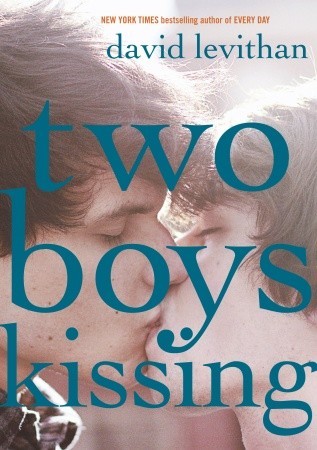
Two Boys KissingTwo Boys Kissing by David Levithan


New York Times  bestselling author David Levithan tells the based-on-true-events story of Harry and Craig, two 17-year-olds who are about to take part in a 32-hour marathon of kissing to set a new Guinness World Record—all of which is narrated by a Greek Chorus of the generation of gay men lost to AIDS. 

While the two increasingly dehydrated and sleep-deprived boys are locking lips, they become a focal point in the lives of other teen boys dealing with languishing long-term relationships, coming out, navigating gender identity, and falling deeper into the digital rabbit hole of gay hookup sites—all while the kissing former couple tries to figure out their own feelings for each other. (blurb from Goodreads)

Rating: PG, 5 stars
Trigger warnings: homophobia, AIDS, suicide attempt

This book. Oh, I have all the feelings for this book. Let’s start with the fact that I read this entire book in one sitting. In about two and a half hours. And I cried almost the entire time. Seriously, I started crying within the first five pages, and although I cry a lot when I read, it’s usually at the end of the book, not at the beginning.

The book starts out with the “Greek Chorus” of men who were lost to AIDS, written in a poetic and immediately-evocative style. Because I’m me and once I’m interested in a book, I don’t go back and read the blurb when I actually start to read the book, I didn’t realize that this was a sort of framing narrative for the novel. Although I’d assumed the entire book would be written in that fashion, I wasn’t disappointed when it shifted focus onto specific, living characters. All in all, I thought the writing struck that balance between plot-driven and poetic, catching the attention of both readers who appreciated every individual word and readers who focus on the bigger picture.

There were times that I found myself frustrated by the overwhelming focus on gay men, an already-dominant demographic in LGBTQ literature. However, I felt like this book was very clearly the story of gay men, and so the lack of bisexual and lesbian characters did not feel as harmful as it could have been. Two Boys Kissing doesn’t market itself as queer YA but as gay YA. Others may disagree with me, but even though the lack of other queer identities was frustrating, I was ultimately ok with it.

*SPOILER* I think part of why I loved this book so much is because it kept seeming like it would be a sad book, but everything ended on a positive, hopeful note. It’s so important to have books with gay characters who face a lot of the same problems other gay teens face without those problems being sugar-coated. By ending the book on a hopeful note instead of a “happily-ever-after” note, it felt both realistic and positive. *END SPOILER*

All in all, this was an excellent book. The writing is good, the characters are sympathetic, and it is gripping enough to make me read it in one sitting.

Sunday, December 1, 2013

Bi: Notes for a Bisexual Revolution by Shiri Eisner


Bi: Notes for a Bisexual RevolutionBi: Notes for a Bisexual Revolution by Shiri Eisner

Depicted as duplicitous, traitorous, and promiscuous, bisexuality has long been suspected, marginalized, and rejected by both straight and gay communities alike.

Bi takes a long overdue, comprehensive look at bisexual politics—from the issues surrounding biphobia/monosexism, feminism, and transgenderism to the practice of labeling those who identify as bi as either "too bisexual” (promiscuous and incapable of fidelity) or "not bisexual enough” (not actively engaging romantically or sexually with people of at least two different genders). In this forward-thinking and eye-opening book, feminist bisexual and genderqueer activist Shiri Eisner takes readers on a journey through the many aspects of the meanings and politics of bisexuality, specifically highlighting how bisexuality can open up new and exciting ways of challenging social convention.

Informed by feminist, transgender, and queer theory, as well as politics and activism, Bi is a radical manifesto for a group that has been too frequently silenced, erased, and denied—and a starting point from which to launch a bisexual revolution. (blurb from Goodreads)

Rating: PG-13, 4 stars
Trigger warnings: see review

This book took me a long time to get through, but not because I didn’t like it. I found it absolutely fascinating. The problem was, with school and all, I often found it hard to focus while I was reading it. In those moments, I would call it fascinating, but dense. From the perspective I have now, from having finished it over Thanksgiving break, I recognize that it wasn’t so much that it was dense, but more that it was more similar to the books I was reading for classes than the books I read for fun. So it took me awhile, but that wasn’t a bad thing.

In a way, I’m glad it took me so long to finish this book, because that gave me plenty of time to process. When it comes to ideological stances, I find that I often either accept or reject the whole of the ideology almost immediately. Not so with this book. I found there were things I definitely agreed with, but there were also things that I definitely disagreed with, and there were even things that I was (and am) on the fence about. It wasn’t comfortable, but I’m glad about that. This isn’t supposed to be a comfortable book. It asks tough questions about what it means to be bisexual, and the answers are no more comfortable than the questions.

This book was incredibly user-friendly. Like many textbooks from my primary school days, it highlighted “vocabulary words” right in the text and defined them in a separate box on the same page. This is very handy for people who might not be familiar with feminist and queer jargon. Trigger warnings were placed before the sections of the book that were relevant, even down to the paragraph, and there were additional “warnings” placed at the end of the triggering sections. I absolutely loved this idea, and I wish more writers (or editors?) took this approach. The availability of trigger warnings within the text is why I didn’t include them above (mostly because I’m slightly lazy and didn’t want to look up specific trigger warnings, because many of them were very specific). All I can say is that Eisner covered her bases when it comes to potentially triggering passages.

One aspect of the book that I definitely have mixed feelings about is the type of parallels she draws between bisexuality and other social issues/oppressed groups. While Eisner always makes clear that true parallels really don’t exist, and that one oppressed group isn’t better/worse off than any other (because you can’t compare them like that), she does often compare the bisexual movement to other movements, and she often chooses movements that she has connections to or experience with, such as trans* movements and movements specific to Israel/Occupied Palestine. This is where the mixed feelings come in. It was often hard for me to make the connections, because she used movements that I really have no familiarity with. This frustrated me, but I also recognize that Eisner isn’t an American author, so it wouldn’t even make sense for her to solely use American social movements, not to mention the fact that movements besides mainstream American social movements deserve attention. I recognize that my frustration comes from a place of privilege, and part of me enjoyed learning about social movements that I really had no prior knowledge of. But I was also frustrated quite a bit. Hence my mixed feelings.

Overall, this book is an excellent, both for bisexuals and those who identify on the queer spectrum, but also for feminists and anyone who is open to learning about bisexual issues. Be prepared to be uncomfortable while reading, maybe even angry--but hopefully you’ll take that discomfort the way I did by appreciating how relevant it is to the discussion this book is starting.

Note: I received a free ebook copy for review, but I also purchased a copy when I was financially able to. 

Wednesday, October 16, 2013

If You Could Be Mine by Sara Farizan

If You Could be Mine by Sara Farizan

In this stunning debut, a young Iranian American writer pulls back the curtain on one of the most hidden corners of a much-talked-about culture.

Seventeen-year-old Sahar has been in love with her best friend, Nasrin, since they were six. They’ve shared stolen kisses and romantic promises. But Iran is a dangerous place for two girls in love—Sahar and Nasrin could be beaten, imprisoned, even executed if their relationship came to light.

So they carry on in secret—until Nasrin’s parents announce that they’ve arranged for her marriage. Nasrin tries to persuade Sahar that they can go on as they have been, only now with new comforts provided by the decent, well-to-do doctor Nasrin will marry. But Sahar dreams of loving Nasrin exclusively—and openly.

Then Sahar discovers what seems like the perfect solution. In Iran, homosexuality may be a crime, but to be a man trapped in a woman’s body is seen as nature’s mistake, and sex reassignment is legal and accessible. As a man, Sahar could be the one to marry Nasrin. Sahar will never be able to love the one she wants, in the body she wants to be loved in, without risking her life. Is saving her love worth sacrificing her true self? (blurb from Goodreads)

Rating: PG-13, 4 1/2 stars
Trigger warnings: homophobia, transphobia, body dysmorphia, child prostitution

This book actually frustrated me quite a bit, but only in the sense that I wanted to reach through the book and shake Sahar several times.  It was very difficult for me to understand how she could be so in love with Nasrin that she would “fake” being trans*, even to the point of undergoing surgery. This frustration wasn’t a bad thing, though. It was fascinating to follow Sahar’s journey, despite how uncomfortable it made me. I also appreciated the fact that the book told the story of a queer teen who isn’t living in White America, which is something that I think a lot of LGBTQ YA does.

This was a really different book for me to read compared with other LGBTQ YA because the culture is so different. It is a contemporary setting non-Western setting, which I think places it in a really unique position. If my memory serves me, this is the first book I’ve read that clearly checks both those boxes. The non-Western-set books I can think of are speculative, and while there is value in building a speculative world around queer culture, I think there’s a different sort of value to taking a contemporary non-Western (and more specifically, a non-American) culture and really delving into what that means for queer-identified characters.

I liked that the setting and overall concept allowed this book to escape so many tropes, not just of queer YA, but of YA fiction in general. This wasn’t a coming out story. From the very beginning, Sahar and the reader know that she is gay. So she isn’t coming to terms with her own sexuality, and the cultural restrictions mean that she can’t safely broach the topic with most of the people in her life. *SPOILER ALERT* I also enjoyed how the book sidestepped the overused YA trope of “protagonist ends up dating forever their first true love.” There are times when I enjoy the trope, but even then I recognize that it’s overused, and it’s so refreshing to see something different. *END SPOILER*

Overall, I just really enjoyed the book. It made me cry (big surprise), and I definitely can’t wait to read the author’s next book.

Wednesday, July 31, 2013

Huntress by Malinda Lo

Huntress by Malinda Lo


Nature is out of balance in the human world. The sun hasn't shone in years, and crops are failing. Worse yet, strange and hostile creatures have begun to appear. The people's survival hangs in the balance.
To solve the crisis, the oracle stones are cast, and Kaede and Taisin, two seventeen-year-old girls, are picked to go on a dangerous and unheard-of journey to Tanlili, the city of the Fairy Queen. Taisin is a sage, thrumming with magic, and Kaede is of the earth, without a speck of the otherworldly. And yet the two girls' destinies are drawn together during the mission. As members of their party succumb to unearthly attacks and fairy tricks, the two come to rely on each other and even begin to fall in love. But the Kingdom needs only one huntress to save it, and what it takes could tear Kaede and Taisin apart forever.
The exciting adventure prequel to Malinda Lo's highly acclaimed novel Ash is overflowing with lush Chinese influences and details inspired by the I Ching, and is filled with action and romance. (blurb from Goodreads)


Rating: PG-13, 4 1/2 stars
Trigger Warnings: battle/fight scenes, violence, animal attacks, violence directed at children and babies, death


I actually enjoyed Huntress much more than Ash. Lo worked with a larger cast of characters in Huntress than Ash, and consequently there were a lot more characters that I sympathised with. Maybe it was because of the omniscient narration, but I cared about more than just Kaede and Taisin. I enjoyed the moments that focused more on Prince Con and the other members of their traveling party.


Those who have read Ash may recognize the bare bones of the story as one of fairy tales from Ash’s time. Since this is a prequel, Huntress is set in the same world as Ash, just much earlier in history. I really enjoyed the connections, particularly the transformation of the events in Huntress to the folklore in Ash. However, the two novels are not directly connected in terms of characters and immediate setting; you can definitely read one without the other.


I was surprised at the extent of the romance in the story. It is definitely more of an adventure novel than Ash, but the romance was still a main focus. I’d say for at least 90% of the novel there was a good balance between the romance and the action. There were a few moments when I felt the focus shifted too much to one side, but they were very rare.


I thought the the world-building was done very well, and I particularly like Lo’s take on traditional faerie lore. I liked the fact that not all of her fey were explicitly antagonistic. I liked the combination of traditional Celtic Sidhe with the Chinese-influenced spelling “Xi.” And I have to say, I really appreciate it when authors work the whole iron thing into their faerie stories.


*SPOILER* My biggest complaint with Huntress was the unicorn sub-plot at the end. It makes sense in context with Ash, because that part did play a part in Ash. However, I felt like it’s placement in the story made the ending a little anti-climactic for the amount of time given to the unicorn scene. I knew that I was like ten pages from the end of the book, and all of a sudden Kaede is sent on another mission. That just bothered me a little. However, I will say that I appreciate what that scene did for Kaede’s character. *END SPOILER*


There was quite a bit of violence in the book, including a scene where the characters were attacked by wolves, and two scenes that featured violence against infant-like creatures. In addition, some characters do die. So generally speaking, if violence bothers you, you might want to hold off on Huntress, or at least take it slowly. The violence was in no way out of place, given the story, but it was very much there.


All in all, I really enjoyed Huntress. I look forward to reading more of Lo’s work, and I hope she returns to the setting of Ash and Huntress in the future.

Wednesday, July 24, 2013

The Miseducation of Cameron Post by Emily M. Danforth

The Miseducation of Cameron Post by Emily M Danforth

When Cameron Post's parents die suddenly in a car crash, her shocking first thought is relief. Relief they'll never know that, hours earlier, she had been kissing a girl.

But that relief doesn't last, and Cam is soon forced to move in with her conservative aunt Ruth and her well-intentioned but hopelessly old-fashioned grandmother. She knows that from this point on, her life will forever be different. Survival in Miles City, Montana, means blending in and leaving well enough alone (as her grandmother might say), and Cam becomes an expert at both.

Then Coley Taylor moves to town. Beautiful, pickup-driving Coley is a perfect cowgirl with the perfect boyfriend to match. She and Cam forge an unexpected and intense friendship--one that seems to leave room for something more to emerge. But just as that starts to seem like a real possibility, ultrareligious Aunt Ruth takes drastic action to "fix" her niece, bringing Cam face-to-face with the cost of denying her true self--even if she's not exactly sure who that is.

The Miseducation of Cameron Post is a stunning and unforgettable literary debut about discovering who you are and finding the courage to live life according to your own rules. (blurb from Goodreads)

Rating: PG-13, 4 stars
Trigger Warnings: homophobia, ex-gay camp, familial death, drugs, transphobia, sexual content

This was another one of the books that I read while at Plum Village monastery, and like Wildthorn, it eerily paralleled my experiences...must be something about following a more rigid schedule (if you can call a mindful, monastic schedule rigid) while reading about someone following a rigid schedule.

Like Ash, I feel like the blurb to this book was slightly misleading. I expected the majority of the book to take place at the pray-the-gay-away camp and for the book to have a much darker tone overall. I was pleasantly surprised at the lighter tone of the novel and at the depth of the characters. I did not expect to see Cameron struggle so much with her identity or with the death of her parents, and I’m glad she did. It’s refreshing to see a novel with a gay protagonist who struggles not with coming out, but accepting her identity and coming to terms with how that will affect those around her in both positive and negative terms. It was also nice to see that the main focus of the novel was not a romance. There were some flings throughout the course of the novel, but they absolutely were not the main plot.

Given that this is essentially a book about a lesbian teenager in the 80s subverting her aunt’s conservative Christian culture, I wasn’t surprised at the swearing and drug content, but some might be bothered by it. Nothing stronger than marijuana is ever used in the book, but there is swearing left and right, as you might expect from the rural Montana setting. There are also some rather sexual dream scenes that culminate in a non-dream sexual scene.

All in all, this was a really pleasant read full of realism and well-developed characters. The Miseducation of Cameron Post does an excellent job of dealing with some heavy topics while still remaining a moderately light-hearted novel. I recommend it for fans of contemporary YA, (recent) historical YA, and gay protagonists/sexual identity novels.

Wednesday, July 17, 2013

Teeth by Hannah Moskowitz

Teeth by Hannah Moskowitz


Be careful what you believe in.


Rudy’s life is flipped upside-down when his family moves to a remote island in a last attempt to save his sick younger brother. With nothing to do but worry, Rudy sinks deeper and deeper into loneliness and lies awake at night listening to the screams of the ocean beneath his family’s rickety house.


Then he meets Diana, who makes him wonder what he even knows about love, and Teeth, who makes him question what he knows about anything. Rudy can’t remember the last time he felt so connected to someone, but being friends with Teeth is more than a little bit complicated. He soon learns that Teeth has terrible secrets. Violent secrets. Secrets that will force Rudy to choose between his own happiness and his brother’s life. (blurb from Goodreads)


Rating: R, 5 stars
Trigger warnings: bestiality, violence, sexual assault


This book got a lot of buzz on the YA blogs I follow because it featured both gay teens and mermaids (er, fishboys), and in particular the gay teen loved the fishboy. That buzz really interested me both because mermaid books are usually about the, uh, maids, and because the speculative novels I’ve read with LGBTQ teens more often have gay-identified girls. Contemporary YA has far more gay boys than girls, but speculative fiction seems to be the opposite. Basically, buzz=color me curious.


I have to say, I think a lot of the buzz about Teeth was really misleading in everything from Rudy’s sexuality to the extent of his relationship with Teeth, but I am totally ok with that. In fact, I like what the book was so much more than what the buzz had me thinking it would be. I applaud Moskowitz for writing a book about exploring sexuality that isn’t a coming out story. From the beginning of the book, we hear a lot about how Rudy was quite the ladies’ man before moving to the island. He’s comfortable with having sex without being a braggart (which in itself was refreshing). There are no mentions of romantic or sexual relationships with dudes. And yet, by the time Rudy realizes that he has romantic feelings for Teeth, he doesn’t freak out because Teeth is male. He doesn’t even freak out because Teeth is part fish. There’s no lonely walks filled with angsting about how attracted he is to Fish Boy. Rudy is, quite simply, focused on the more complicated aspects of their relationship, like the fact that his brother is only alive because he is eating the fish that Teeth loves. For that matter, Rudy’s feelings for Teeth were subtle enough that had I not known the buzz beforehand (and had I skimmed the book’s blurb), I might not have picked up on the romantic tension at all.


Basically, it was incredibly refreshing to see a YA novel with a gay protagonist that was so much more than a YA novel about a gay protagonist. Rudy is a complicated character with a complicated romantic and sexual life, but at the end of the day that isn’t all he is. So much in Teeth was handled subtly, from sexuality to assault. The relationships between the characters were rich and complex, which made this book so much more than what I’d heard about it.


Trigger-wise, the bestiality is from a flashback, and it deals with Teeth’s conception, not Teeth. I only put that warning in because only one party in that scene had the capacity to consent. There are a lot of mentions of sexual assault, but Rudy never sees any of them up close. The descriptions of violence do get pretty intense at times, especially at the end, but not nearly as intense as in Dualed, the last violent novel I reviewed.

Teeth is an dark, complex novel that will appeal to sci-fi fantasy lovers, those seeking LGBTQ romance (although they *might* be slightly disappointed by amount of romantic details), as well as those who like gritty contemporary novels--Rudy seemed a lot like a contemporary character who accidentally wandered into a speculative setting. Teeth is an excellent book, and if you pass on it, you’re missing out.

Wednesday, July 10, 2013

Wildthorn by Jane Eagland

Wildthorn by Jane Eagland

Seventeen-year-old Louisa Cosgrove longs to break free from her respectable life as a Victorian doctor's daughter. But her dreams become a nightmare when Louisa is sent to Wildthorn Hall: labeled a lunatic, deprived of her liberty and even her real name. As she unravels the betrayals that led to her incarceration, she realizes there are many kinds of prison. She must be honest with herself - and others - in order to be set free. And love may be the key... (blurb from Goodreads)

Rating: PG-13, 4 stars
Trigger Warnings: institutional abuse, familial abuse, death

When I first heard about Wildthorn a few years ago, I got a vibe that it hit a subgenre that I rarely see covered: lesbian historical YA. YA novels featuring gay characters are becoming more and more prominent, but most of them seem to focus on gay males, and historical fiction with LGBTQ characters is still rare. So when I got this vibe, I was instantly intrigued and snagged the ebook when I had the chance.

I really appreciate the way everything unfolded in Wildthorn. I thought the concept of Louisa knowing everything and not telling the reader worked really well, even though it could have failed drastically. Fortunately, it didn’t, and I enjoyed not knowing things before the protagonist for once.

I had an interesting experience reading this book, because I read it while I was on a retreat at a Buddhist monastery. In many ways, my routine was similar to Louisa’s at the asylum, although my experience was entirely positive: I had set wake up times and meals; there were afternoon activities and chores; and all the laypeople had very different reasons for being there. So it was really different to read this book in circumstances that were so similar and yet almost the opposite of Louisa’s.

The setup of the book surprised me. The vibe I got was that the book would be entirely about Louisa’s sexuality, but I was pleasantly surprised to find that that wasn’t her only characteristic, and wasn’t what her family saw in her at all. I think there’s a risk in these sorts of YA novels for sexuality to be the protagonist’s only defining feature, and I was pleased that Louisa was a fully fleshed-out character.

In general, I thought all the characters were well-developed and realistic. I had some slight issues with how accepting Eliza’s family was, given the Victorian time period, but it didn’t seem out of their characters, just out of place for the time.

I think Wildthorn is a fascinating novel for readers today, particularly for female readers. *SPOILER* Considering that Louisa is locked up for reading, wanting to go to college, having priorities other than perfecting her appearance, among other things, female readers will likely really empathize with her based on these potential similarities. I know I did. *END SPOILER*

Wildthorn is a dark novel, and institutional abuse is prevalent, as is some familial abuse at the hands of Tom, Louisa’s brother. However, I’ve certainly read darker novels, and no part of Wildthorn was so intense that I actually had to put it down. It’s a good work of historical fiction, and it opens up some new perspectives for the reader.

Wednesday, July 3, 2013

Ash by Malinda Lo

Ash by Malinda Lo


In the wake of her father's death, Ash is left at the mercy of her cruel stepmother. Consumed with grief, her only joy comes by the light of the dying hearth fire, rereading the fairy tales her mother once told her. In her dreams, someday the fairies will steal her away, as they are said to do. When she meets the dark and dangerous fairy Sidhean, she believes that her wish may be granted.


The day that Ash meets Kaisa, the King's Huntress, her heart begins to change. Instead of chasing fairies, Ash learns to hunt with Kaisa. Though their friendship is as delicate as a new bloom, it reawakens Ash's capacity for love-and her desire to live. But Sidhean has already claimed Ash for his own, and she must make a choice between fairy tale dreams and true love.


Entrancing, empowering, and romantic, Ash is about the connection between life and love, and solitude and death, where transformation can come from even the deepest grief. (blurb from Goodreads)


Rating: PG, 4 stars
Trigger Warnings: some violence, familial/domestic abuse (à la Cinderella)


For the record, Cinderella retellings are my thing. My favorite books as a child include Ella Enchanted, Just Ella, and The Glass Slipper. I don’t know anyone else that has even heard of The Glass Slipper (please shout out if you have!). So when I found Ash on sale over a year ago, I was super pumped. A new Cinderella retelling! Unfortunately, I think it is misleading to bill Ash as a Cinderella retelling. I can definitely see parts of the story that were taken from Cinderella. Ash lives with her stepmother and stepsisters. She works like a servant for them and endures their ridicule and abuse. The prince holds a ball for every eligible maiden in the kingdom. That’s about the end of the Cinderella parallels, though. This isn’t necessarily a bad thing; to the contrary, I really enjoyed this book. I just think it shouldn’t have been marketed as a Cinderella retelling. Because that’s not what it is. More on exactly why it isn’t to come.


But if it’s not a Cinderella retelling, what did I like about it? So. Much. Ash felt so real, so human. Her emotions were so raw, which is something not often found in stories that take inspiration from Cinderella. It was really refreshing to see a fairy tale base made so human and genuine. I enjoyed the world-building. I felt the culture was well-integrated, and the role of the King’s Huntress made me really happy. So many fantasy worlds either stick with the status quo and have their military and influential figures male or equally male and female, and here was a martial position that was for women. I really enjoyed that.


I think one of Malinda Lo’s strong suits in writing is writing the gradual development of relationships. It’s something hard to do, and yet I think Lo captures it beautifully in Ash.


I also enjoyed her adaptation of common Cinderella elements. The use of the name Ash plays to both the novel’s Celtic influences and a synonym for cinders. I enjoyed her substitution of a fairy for the fairy godmother/tree/whatever.


Now for complaints. Er, complaint, since I already went over the not-fairy tale thing. I said I loved the world building, but there was one aspect that was frustratingly missing. *SPOILER?* When Ash starts to realize she has feelings for Kaisa, she is concerned about what people will think. Kaisa is clearly not concerned. Since Ash was a little sheltered from people, I assumed that she just didn’t understand the culture’s view of homosexuality, but I wanted a definitive answer on that. I wanted someone to say something or do something that revealed the general acceptance or lack thereof of homosexuality. This was a major frustration for me. *END SPOILER*


Now, for why this isn’t a fairy tale retelling to me. *SPOILER* For me, Cinderella stories are a lot about the prince. In the original tale and most retellings, he is the catalyst for change. He changes the Cinderella figure’s life, whether that is in a good way or not. In Ash, he’s basically a background character. This isn’t “the prince falls for Ash and she chooses the Huntress anyway.” This isn’t “the princess falls for Ash and she falls for the princess.” This isn’t even “the prince falls for Ash but she likes his sister.” No. The prince is there, but Ash dances with the Huntress and then her fairy boy gets pissed. To me, this departure from the how and the why of Cinderella is why Ash isn’t a fairy tale retelling. It is inspired by Cinderella, but no more than that. *END SPOILER*

All in all, I really enjoyed Ash. There were some moments of frustration, but they didn’t really cloud my enjoyment of the book. I thought the writing was beautiful and the characters well-developed. It’s definitely worth reading.